
Key Points
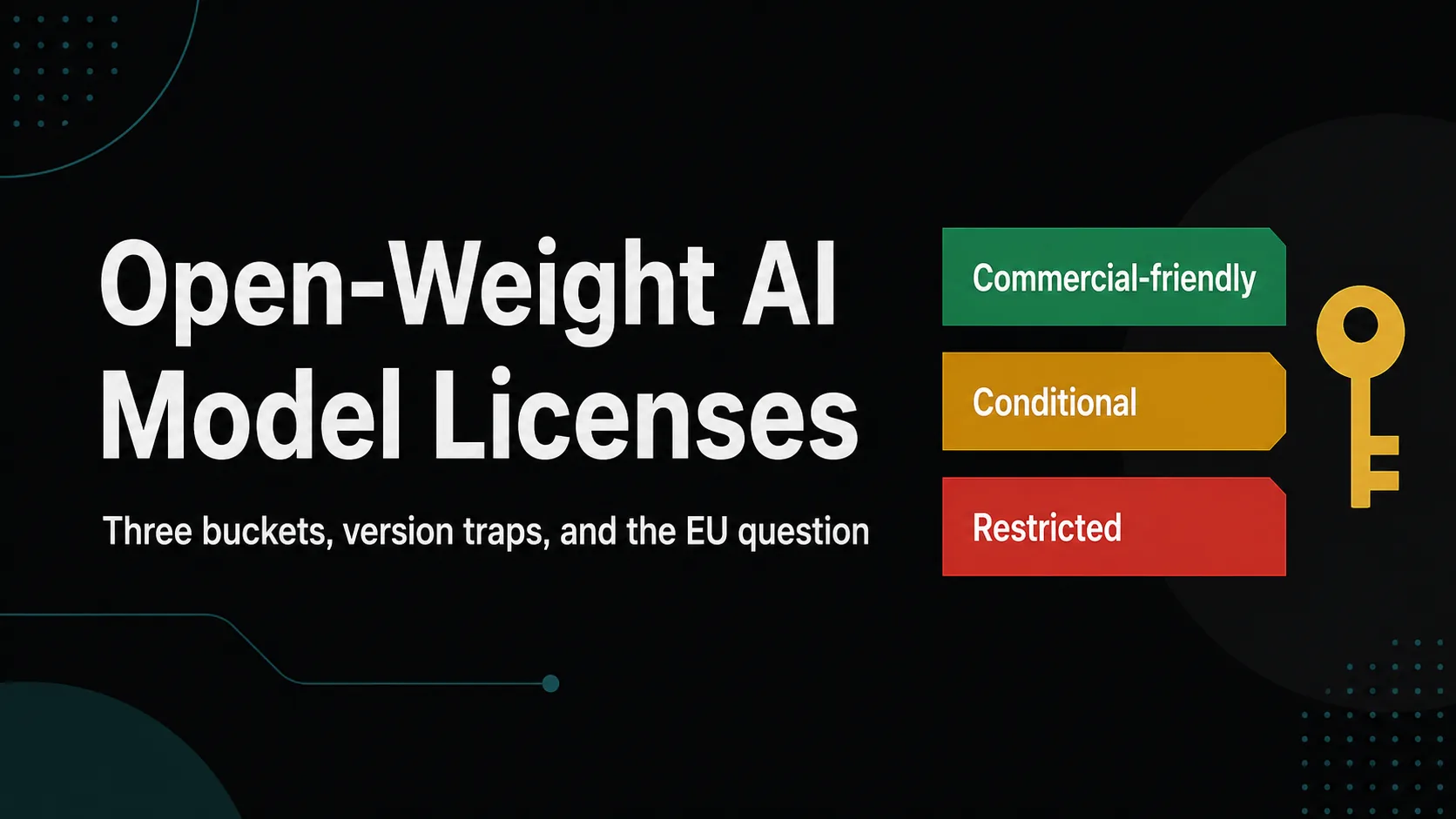
- "Open" does not always mean free for commercial use. An AI model's weights carry a license layer separate from the software (OSS) license — sort models into three buckets: Apache/MIT, conditional community licenses (Llama, Gemma), and restricted / non-commercial (RAIL, non-commercial).
- Written for developers and practitioners (US/EU) who run open-weight models — LLMs, image, and audio — in their own products or work.
- You leave with a commercial-use cheat sheet spanning LLMs plus image and audio models, and a use-case checklist for personal / internal / customer-facing SaaS.
- Out of scope: this is educational material, not legal advice, and license values are accurate as of the writing date only. The two points most misunderstood in English coverage — the EU restriction on Llama is a contractual choice, not an export control, and open-weight models were never in scope of the rescinded AI Diffusion Rule — are addressed directly below.
Want the cheat sheet only? Jump to the tables in each category. Wondering whether you can use Llama in the EU? Skip to "Llama and Gemma's 'looks fine, but…' clauses." Want to judge by your own use case? Go to the checklist at the end. 日本語版 (Japanese version, Japan-jurisdiction): AIモデル(重み)のライセンス早見表.
Written: 2026-06-13 / Jurisdiction in focus: United States & EU (other regions referenced as background)
Educational material, not legal advice
⚠ This article is educational material, not legal advice. Model versions, licenses, geographic restrictions, and MAU / revenue thresholds change without notice (see the Qwen and Stability examples below). This is a snapshot at the writing date — always confirm each model's current official LICENSE and Acceptable Use Policy before you rely on it. For commercial integration or large-scale distribution, review by your legal / IP owners is assumed.
This article is part of a series on software rights and licensing. For reading code-side licenses, see Reading OSS licenses; for the API-vs-weights terms-of-service side, see Reading AI service terms; for export controls, see Export controls for builders.
Mini-glossary:
- Weights: the trained parameters that are the model. The terms for distributing and using them are the "model license."
- Open-weight: a model whose weights are published for download. "Downloadable" does not imply "free for commercial use."
- Hugging Face: the most common platform for publishing and distributing AI models and datasets; most open-weight models are hosted there.
- Community license: a vendor's own, non-OSI license (Llama Community License, Gemma Terms of Use). Commercial use is allowed, but with custom conditions.
- RAIL (Responsible AI License): a license that embeds a list of prohibited uses and propagates them to derivatives (used by Stable Diffusion, StarCoder 2).
- AUP (Acceptable Use Policy): the policy defining permitted and prohibited uses of a model; a violation can be grounds for license termination (it also appears in the figures).
- MAU (Monthly Active Users): the metric Llama's license draws a line at — 700 million — judged as of a version's release date.
- Consumer (to-C) service: a service aimed at general consumers (business-to-consumer).
- Vision / multimodal model: a model that handles inputs beyond text (Vision = images; multimodal = text, image, audio, and more, together).
- High-stakes automated decision: an automated decision in a domain affecting individual rights — credit, hiring, healthcare, housing — which many licenses prohibit.
- HR tech: technology and services that support hiring and human-resources work.
When you reach for an AI model, it is tempting to assume "if I can download it from Hugging Face, I can use it freely." But a model's weights carry a license separate from the code, and "open" often does not mean free for commercial use — or comes with conditions. This article sorts the major open-weight models into three buckets and gives you a cheat sheet plus a use-case checklist (personal / internal / customer Software as a Service: software used over the network as a service rather than installed locally.See glossary →) so you can decide what to check for your own situation. Along the way it clears up the two points English-language coverage most often gets wrong: what the EU restriction on Llama actually is, and what the rescinded US "AI Diffusion Rule" did and did not cover.
Why "open" doesn't always mean free for commercial use
The key idea is that the license on the weights is a different layer from the code (Open Source Software: source code is published and anyone may use, modify, and redistribute it within the license terms.See glossary →) license. Inference code can be Apache 2.0 or MIT while the weights it loads carry their own conditions — "research only," "not for EU companies," "needs a separate contract above 700M MAU." A repository being open source does not mean the model is free to use commercially.
![A three-tier map of model-weight licenses. Top green band A (commercial-friendly OSS: Apache/MIT, Qwen3, Gemma 4, Whisper); middle amber band B (conditional community: Llama with MAU+EU, Gemma high-stakes); bottom red band C (restricted/non-commercial: RAIL SDXL, Flux.1 [dev], Codestral 22B, CC BY-NC). A note below: terms differ by version/size even within a bucket.](/blog/ai-model-licenses-for-builders/fig2_en.webp)
Most open-weight licenses fall into three buckets:
| Bucket | Nature | Examples | Commercial use |
|---|---|---|---|
| A. Commercial-friendly OSS | Apache 2.0 / MIT. Free for commercial use — but watch for version/size exceptions | Mistral 7B/Mixtral, Qwen3, DeepSeek-R1, Phi, GPT-OSS, Whisper, Gemma 4 | Generally as-is |
| B. Conditional community | Non-OSI vendor licenses. Commercial use allowed, but with MAU / geographic / use-type conditions | Llama family, Gemma (through Gemma 3) | OK if conditions are met |
| C. Restricted / RAIL / non-commercial | Inherited prohibited-use lists (RAIL), or a ban on production/commercial use at all | Stable Diffusion family, Flux.1 [dev], Codestral 22B, Command R+ | Conditional, or not at all |
The rest of this article walks A → B → C, then ends with a checklist for your use case (personal / internal / customer SaaS).
The basics of the license families themselves (what Apache, MIT, and copyleft are) are covered in Reading OSS licenses. This is the "models" companion to it.
Category A — the Apache/MIT trap (it changes by version and size)
This bucket is easy to use commercially. The biggest trap is that the same model name can carry different licenses across versions and sizes. "Mistral is Apache, so we're fine" is exactly where teams slip.
| Model | License | Watch out for | Check before you rely on it |
|---|---|---|---|
| Mistral 7B / Mixtral | Apache 2.0 | The same vendor's Large 2 and Codestral 22B are non-commercial (a different line). Don't conflate them | Confirm the version you use is Apache on its HF model card |
| Qwen 2.5 | 7B/14B/32B = Apache, 72B = custom (100M MAU), 3B = research-only (no commercial) | Conditions differ by size | Check the LICENSE per size |
| Qwen3 / QwQ-32B | Apache 2.0 (MAU limit removed) | Moving to Qwen3 simplifies terms vs 2.5-72B | Qwen3-Coder- and similar derivatives: check individually |
| DeepSeek | R1 = pure MIT, V3 = MIT code + custom model license (use restrictions) | R1 and V3 are structured differently | V3's use restrictions must pass down to your end-user terms |
| Phi-3 / 3.5 / 4 | MIT | The model card's "Responsible AI" notes are recommendations, not legal restrictions (the card says so) | — |
| GPT-OSS / Whisper | Apache 2.0 | Using "GPT-OSS" in a derivative's name can raise trademark issues | — |
| Falcon | 7B/40B = Apache, 180B = custom (offering a shared / third-party inference or FT API needs TII approval) | Only 180B has a hosting-use restriction; internal / dedicated-instance use is exempt | If you offer 180B as a shared API to third parties, apply to TII |
In short, even in bucket A the minimum is to read the LICENSE of the exact version and size you use, once, with your own eyes. A vendor moving its flagship to non-commercial (Mistral), or a size being research-only (Qwen 2.5-3B), is common.
Note: Mistral has moved its flagship models to non-commercial licenses since 2024; the Apache 2.0 ones are specific earlier releases (Mistral 7B, the Mixtral models). Newer models warrant a fresh check.
Llama and Gemma's "looks fine, but…" clauses
Llama and Gemma both say "commercial use allowed," and in most cases they work. But each attaches scale / geographic / use-type conditions, with different character.
Llama — the 700M MAU clause and the EU multimodal restriction
Across the family (Llama 2 through Llama 4), the license carries a 700-million-MAU clause: a licensee whose monthly active users exceed 700M as of a version's release date needs a separate license from Meta (granted at Meta's sole discretion). Because it is judged at the release date, later growth is not retroactive, but a new version triggers re-judgment. In practice only a handful of mega-services hit this — confirm it if you run a large consumer service.
The clause that affects more developers is the EU multimodal restriction. Introduced in Llama 3.2, it applies to Llama 3.2 Vision (11B / 90B) and all of Llama 4. The rights are not granted to "an individual domiciled in, or a company with a principal place of business in, the European Union" for these vision / multimodal models — so an EU-based company cannot self-deploy, modify, or redistribute them. End users in the EU can still use a product that incorporates them (the restriction targets the licensee, not the end user). Text-only models (Llama 3.2 1B/3B, Llama 3.3 70B) are not affected and remain available in the EU.
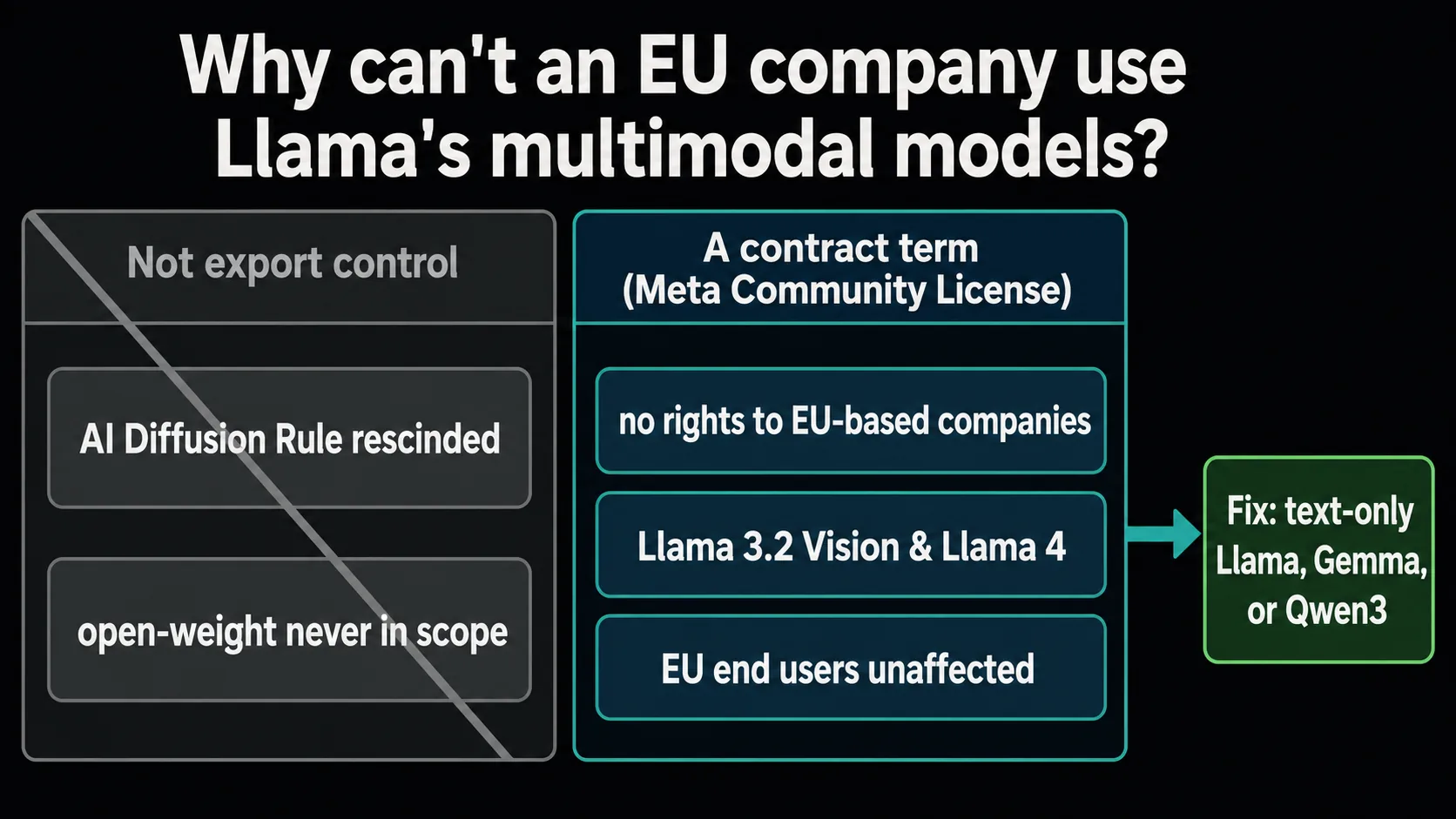
Here is the point English coverage most often gets wrong: this EU restriction is not an export control. It is a contractual licensing restriction that Meta itself imposes — not something the US Export Administration Regulations (EAR) or any EU export rule levied against Llama by name. Meta has publicly cited "current regulatory uncertainty" (Meta newsroom, 2024-08-23) as the reason, with the background widely understood to be uncertainty around the EU EU AI Act (Regulation (EU) 2024/1689): the EU's comprehensive AI law. It is commonly described as four risk tiers, but that is the Commission's explanatory model, not a statutory taxonomy: the Regulation is structured as Art.5 (prohibitions), Art.6 + Annex III (high-risk), Art.50 (transparency duties, entry into application 2026-08-02) and Chapter V (general-purpose AI models).See glossary → and data-protection law (General Data Protection Regulation: the EU rule governing the handling of personal data of people in the EU.See glossary →); Meta has not named a single specific regulation as the cause.
This distinction is reinforced by what happened on the US side. The "AI Diffusion Rule" (ECCN 4E091), published 2025-01-15, was rescinded on 2025-05-13 — and even while in force, it targeted closed-weight frontier models above a compute threshold; open-weight models were never in its scope. In other words, US export controls do not restrict open-weight Llama, and the rule that might have touched model weights is gone. So "can't use Llama Vision in the EU" is not a customs / export question you solve with a license to export — it is a contract question (Meta has not granted the right to EU-based licensees). The practical fix is therefore not "get an export permit" but "switch to a text-only Llama, or to a model without a geographic restriction such as Gemma or Qwen3."
Providing models to third countries (China, Russia, North Korea, etc.) is a separate axis where export-control law (EAR and others) can apply. That is covered in Export controls for builders and is a different question from the licensing restrictions here.
Gemma — no MAU limit, but no "high-stakes automated decisions"
Gemma (Gemma / Gemma 2 / Gemma 3) differs from Llama in having no MAU limit. Commercial use, modification, distribution, and fine-tuning are all granted, and there is no obligation to prefix derivative names with "Gemma." Even multimodal Gemma 3 has no EU restriction like Llama 3.2's.
What to watch instead is the Prohibited Use Policy. In particular, it explicitly bans "automated decisions in domains that affect material or individual rights or well-being (e.g., finance, legal, employment, healthcare, housing, insurance, and social welfare)." HR tech, credit scoring, and insurance scoring run straight into this clause (a violation is grounds for termination).
Gemma 4 changed license (mind the version gap)
The custom Gemma Terms of Use described here apply through Gemma 3. The latest Gemma 4 (released 2026-03-31) moved to Apache 2.0 — i.e., bucket A in this article's scheme: no MAU limit and no custom prohibited-use clause. So which Gemma you use changes its bucket; the high-stakes ban above is a Gemma-Terms (through Gemma 3) matter.
| Model | Scale / geographic condition | Use condition | Check before you rely on it |
|---|---|---|---|
| Llama 2 / 3 / 3.1 / 3.3 70B (text) | Separate contract above 700M MAU | AUP compliance | Your service's MAU |
| Llama 3.2 Vision / Llama 4 | 700M MAU + not for EU-based companies | AUP compliance | EU-based? Not adoptable → text version / Gemma / Qwen3 |
| Gemma / 2 / 3 (Gemma Terms) | None | No high-stakes automated decisions | Confirm the clause before embedding in credit/health/employment |
| Gemma 4 (2026-03-31+, Apache 2.0) | None | Apache 2.0 (no custom prohibition) | Treat as bucket A; don't confuse versions |
Category C — RAIL and the "no commercial use" minefield
Bucket C mixes two different things: RAIL-style licenses (commercial use is OK, but you must propagate the prohibited-use list) and models that ban production / commercial use outright.
RAIL — commercial OK, but you "inherit" the prohibited uses
RAIL (Responsible AI License) models can be used commercially, but the attached prohibited-use list (Attachment A) must be passed down to derivatives and end-user terms. Stable Diffusion 1.5 / 2.1 / SDXL and StarCoder 2 fall here. Prohibited uses include discrimination, disinformation, impersonation, content involving minors, and certain automated decisions.
In practice, if you ship a SaaS, transcribe these prohibitions into your own terms of service. Note also that SDXL's RAIL++ includes "distillation" and "synthetic-data training" in its definition of derivatives — so training another model on SDXL output makes the restriction chain to that new model (specific to SDXL's RAIL++).
SDXL Turbo was relicensed (don't trust the old tag)
SDXL Turbo's Hugging Face card still shows a sai-nc-community tag, but its LICENSE has been updated to the Stability AI Community License (the same family as SD 3/3.5): commercial use is allowed for organizations under US $1M annual revenue, with an Enterprise License required above that. So it is not "non-commercial only." Treat SDXL Turbo like SD 3.5 (a revenue-threshold model), and always read the current LICENSE.md, not just the card's license tag. Note that the Stability AI Community License requires, even for commercial use under $1M revenue, (a) registering with Stability AI, (b) displaying "Powered by Stability AI", (c) keeping a NOTICE file, and (d) complying with the AUP (SD3 / SD3.5 as well) — it is not "unconditional below the threshold."
Outright "no commercial use" (or heavy conditions) — keep these out of production weights
The following cannot be used commercially / in production as raw weights. Confirm before shipping.
| Model | License | Commercial? | Alternative / workaround |
|---|---|---|---|
| Flux.1 [dev] | Non-commercial | × (very high risk) | [schnell] is Apache 2.0 and commercial-OK, or BFL's paid license / API |
| Codestral 22B | Non-commercial / non-production (MNPL) | × (even internal daily use counts as production) | Codestral Mamba is Apache 2.0, or StarCoder 2 (RAIL) |
| Mistral Large 2 / Pixtral Large | Research only (MRL) | × | Mistral commercial license, or Mixtral (Apache) |
| Command R / R+ / A, Aya | CC BY-NC (non-commercial) | × (internal use risks counting as commercial) | Via Cohere's commercial API |
Flux.1 in particular is opposite across its three editions: [dev] is non-commercial (even selling a LoRA counts as commercial), [schnell] is Apache 2.0 and fully commercial-OK, and [pro] is API-only. "We used Flux" is not enough — you must check which edition. Likewise, plain Codestral 22B is non-commercial, but the similarly named "Codestral Mamba" is Apache 2.0 — opposite terms, confusing names.
These are not "bad models" — vendors chose these licenses to protect their business. To put them in a commercial SaaS backend, swap in an Apache/MIT alternative, or buy a commercial license / API.
A use-case checklist — personal / internal / customer SaaS
Here is the decision material as a per-use-case checklist. Treat it as a first-pass filter for candidate models; before final adoption, production, or redistribution, always confirm each model's official LICENSE text (and consult legal / IP where needed). The lists below are copy-paste ready.
Scenario A: personal projects, PoC, hobby
□ Read the LICENSE / model card of each model you use, once
□ Even for "Apache / MIT," check whether conditions differ by version / size
   - Qwen 2.5: 72B is custom, 3B is research-only / Mistral: Large 2 & Codestral 22B are non-commercial
   - Flux: [dev] non-commercial, [schnell] Apache / DeepSeek: V3 vs R1 differ
□ For personal research/hobby, non-commercial (CC BY-NC, MRL) is often usable under a "personal use" lane
□ If you post outputs to a commercial blog, check the Outputs terms
Scenario B: internal use at a small/mid-sized company
□ Before adoption, confirm the model is usable in the cheat sheets above
□ Map the scale / geographic / revenue conditions to your org
   □ Llama 700M MAU → check your service's MAU
   □ Qwen 2.5-72B 100M MAU → consider moving to Qwen3
   □ Stable Diffusion 3/3.5 $1M annual revenue → check with finance
□ If you are an EU-based company / subsidiary, Llama 3.2 Vision and Llama 4 are off the table
   → alternatives: Llama 3.3 70B (text), Gemma 3, Qwen3
□ Don't embed Gemma (through Gemma 3) in automated finance / health / employment / housing / insurance / social-welfare decisions
□ Codestral 22B, Mistral Large 2, Command R+ count as production even for internal daily use → eval / PoC only
□ For RAIL models (SD, SDXL, StarCoder), transcribe the prohibited-use list into your internal guide
□ Re-check the license on each model update (terms change across versions: SD3→3.5, Qwen2.5→3)
Scenario C: customer-facing SaaS / product distribution (the strictest)
□ Narrow to fully commercial-OK options
   - LLM: Mistral 7B/Mixtral, Qwen3, DeepSeek-R1, Phi, GPT-OSS, Gemma 4, Llama family (check MAU)
   - Code: StarCoder 2, Codestral Mamba (Apache)
   - Image: Flux.1 [schnell], SDXL, SD3.5 (under $1M revenue) / Audio: Whisper
□ For RAIL models, restate the prohibited-use list in your customer terms of service
□ Even for EU customers, if you host as an EU-based company, Llama Vision / Llama 4 are not allowed
□ Honor attribution duties where they apply: "Built with Llama" when distributing a Llama derivative; "Built with Qwen" only for Qwen-custom-license models (e.g., 2.5-72B) when you create and distribute another AI model (Qwen3 Apache has no such duty)
□ Keep non-commercial models (Codestral 22B, Mistral Large 2, Command R+, Flux.1 [dev]) out of the backend
□ Ship the NOTICE file for Apache 2.0 models when redistributing derivatives (easy to forget)
□ Watch for license changes (GitHub Watch, vendor blogs) + a final legal review
One EU-specific obligation: the AI Act's GPAI rules
If you provide a general-purpose AI model (GPAI) — not merely use one — the EU AI Act's GPAI obligations began applying on 2025-08-02 (technical documentation, an EU-copyright-compliance policy, and a public summary of training content). Models already on the market before that date have a transition period until 2027-08-02. There is a FOSS exception that waives the technical-documentation duty for openly licensed models, but it does not waive the copyright-policy and training-summary duties, and does not apply at all to "systemic-risk" GPAI (above a compute threshold). So "publishing weights openly" lightens EU duties only up to a point. Most readers here use models rather than provide GPAI, but if you fine-tune and distribute a large model, this is the obligation to map.
Wrap-up
Open-weight model licenses are not "open = free." The workable approach is to read the weights' license in three buckets and map it to your use case. The minimum checks:
□ Confirm the official LICENSE and the distribution form (weights vs API)
□ Even for Apache / MIT, check whether the version / size you use changes the terms
□ Check whether you fall under an EU-company / large-MAU / high-stakes (credit, health, etc.) condition
□ Before production or redistribution, check derivative / output restrictions and prohibited uses
These four checks alone prevent most "I downloaded it, so I shipped it" accidents.
Two things English coverage gets wrong are worth keeping straight: the EU restriction on Llama multimodal models is a contractual choice by Meta, not an export control, and open-weight models were never in scope of the (now-rescinded) AI Diffusion Rule. Treat geographic limits as license terms to route around (use a text-only or unrestricted model), not as customs problems.
Once you run several models across a team, relying on individual memory stops scaling. At that point the next move is to stop making the judgment ad hoc and run it as a procurement policy (allow / caution / deny list + intake template + monitoring). A companion article, How to build an OSS license policy, covers building that policy in detail (with intake-form and deny-list templates).
As always, this is a snapshot as of 2026-06. Versions and licenses move frequently. Anchor your final decision in the official LICENSE text at the time, and for high-impact cases (commercial integration, large-scale distribution), get a review from your legal / IP owners.
References
Model licenses and use policies (retrieved 2026-06; confirm the latest at each official source):
- Llama Community License / FAQ (Meta; 700M MAU clause, EU multimodal restriction, derivative naming)
- Llama 4 Acceptable Use Policy / Llama 3.2 License (the EU multimodal restriction lives in Section 1(a) of each version's Community License Agreement — the license-grant clause, not the AUP)
- Gemma Terms of Use / Gemma Prohibited Use Policy / Gemma releases & per-version licenses (Gemma 4 is Apache 2.0, from 2026-03-31)
- Qwen2.5-72B license / Qwen3 (Alibaba Cloud)
- DeepSeek-R1 LICENSE / DeepSeek-V3 LICENSE-MODEL
- Phi-4 (MIT) / Whisper (Apache 2.0) / GPT-OSS (Apache 2.0) / Falcon-180B (custom)
- Mistral MNPL-0.1 (Codestral 22B = non-production) / Mistral MRL-0.1 (Mistral Large 2, Pixtral Large = research only)
- FLUX.1 [dev] model card / FLUX.1 [schnell] (Apache 2.0) / BFL Licensing
- Stability AI Community License / SDXL Turbo model card
- CreativeML Open RAIL-M (Stable Diffusion) / BigCode OpenRAIL-M (StarCoder 2)
- Cohere CC BY-NC license (Command R+)
- EU AI Act (Regulation (EU) 2024/1689) (GPAI obligations apply 2025-08-02; transition to 2027-08-02)
- US AI Diffusion Rule (ECCN 4E091): Framework for Artificial Intelligence Diffusion — Federal Register, published 2025-01-15 (it took effect on 2025-01-13, published 2025-01-15, and was rescinded around 2025-05-12/13 — after it took effect but just before its main compliance date of 2025-05-15) / BIS rescinds the AI Diffusion Rule (Wiley). ECCN 4E091 controlled closed-weight models above a compute threshold; open-weight models were never in scope. See also Export controls for builders.