
Key Points
- Whether AI output is protected by copyright turns on one thing: human creative contribution. A prompt-only output — no human selection or editing — leans toward not being copyrightable in either the US or the EU. But "AI made it, so there are no rights" is just as wrong as "the terms say commercial use is OK, so it's my copyrighted work" — and copyright, the service contract, and disclosure duties are separate layers.
- Who this is for: solo, side-project, and enterprise builders in the US or EU who commercialize AI-generated work (images, text, code). No prior legal knowledge needed.
- What you get: how to separate the copyright / contract / disclosure layers + a jurisdiction-by-jurisdiction read (US / EU) + a "do you hold an exclusive right?" commercialization flow + a recordkeeping checklist to keep while you create (by stance).
- What's out of scope: final calls on copyrightability/authorship in a specific case, litigation strategy, current-clause judgments on individual providers' terms (how to read AI service terms), and the lawfulness of AI training data and crawler handling (AI training data and crawlers) — for those, consult a qualified attorney or IP specialist.
この記事の要点(日本語版はこちら)
- 日本法を主軸にした 日本語版 もあります。これは翻訳ではなく、法域別に書き分けた姉妹記事です(日本語版は文化庁「考え方」や日本の無方式主義が中心)。本稿は米国・EU の実務を主軸にしています。
As of: 2026-05 / Jurisdiction focus: United States & EU (Japan is covered in the Japanese edition) / last_updated: 2026-05-31 Changelog: 2026-05-31 first published as an international (US/EU) edition / 2026-06-11 added the "Watermarks and provenance" section (C2PA, SynthID, watermark-removal rules — framed as a layer separate from copyright ownership)
Educational material, not legal advice
The copyright status of AI-generated work is still in motion across jurisdictions — there are pending lawsuits and legislation awaiting adoption — and the law remains unsettled. This article is a general, educational overview, not legal advice on any specific matter, and it makes no warranty as to accuracy, completeness, or currency. Out of scope: final calls on copyrightability or authorship in a specific case, litigation strategy, the details of contract design member state by member state in the EU, current-clause judgments on individual providers' terms (covered in how to read AI service terms), and the lawfulness of AI training data (covered in AI training data and crawlers). For your actual decisions, always consult a qualified attorney or IP specialist, or your in-house counsel. This information is provided "AS IS." Neither the author nor YATA-NODE is liable for any loss or damage arising from its use of or reliance on it. Use at your own risk.
About this series: the hub is the pre-ship rights checklist; the closest companion is how to read AI service terms (the contractual right to outputs). AI training data and crawlers covers training, crawler handling, and the broader EU AI Act picture. Each piece reads on its own — no need to read them in order. A Japanese edition of this article, centered on Japanese law, is at 日本語版.
A few terms (for newcomers):
- Copyrightability: whether something qualifies as a protected "work." In the US and the EU, this presupposes human authorship — a human creative contribution.
- Human creative contribution: how much a person added in expressive choices, judgment, and editing when using AI as a tool. The more there is, the more likely the work is copyrightable.
- Prompt-only: output produced by entering a prompt alone, with no human selection or edits applied to it. In both the US and the EU this leans toward not being copyrightable.
- Registration (US) vs. formality-free protection: in the US, copyright registration with the U.S. Copyright Office (USCO) is a distinct step; for AI-assisted work, you register only the human-authored portion. Many other jurisdictions grant copyright automatically on creation, with no registration required.
- SCA (selection, coordination, and arrangement): in the US, the human-authored elements — what you selected, coordinated, and arranged — that can be the registrable part of an AI-assisted work.
- IP indemnification (indemnity): a contractual promise by a provider to defend and cover you if a third party claims infringement. It does not guarantee that copyright in the output vests in you.
- EU AI Act, Article 50: a transparency / disclosure layer. Roughly, providers must mark generative-AI output in a machine-readable way, while deployers must disclose certain deepfakes and AI-generated text on matters of public interest — with exceptions (e.g. obviously artistic or satirical works, content under human editorial control). It applies from 2026-08-02 (though the machine-readable marking duty under Art.50(2) for generative-AI systems already on the market receives a grace period until 2026-12-02 under the Omnibus package (agreed May 2026; adopted by the European Parliament on 16 June 2026 and by the Council on 29 June 2026, and awaiting Official Journal publication as of July 2026 — confirm the final date against the published text) and is a separate layer from copyright ownership (untangled in the first section below).
- C2PA / Content Credentials: an industry-standard provenance record that signs "who made this, with which tool, and how it was edited." What it records is the signer's assertion, and it does not determine copyright ownership (covered in the "Watermarks and provenance" section).
- Watermark (e.g., SynthID): a technique that embeds a signal imperceptible to humans so AI-generated output can later be detected. Google DeepMind's SynthID is a leading example. A watermark does not change copyrightability.
First, three misconceptions — copyright, contract, and disclosure are separate layers
Discussions of AI-generated work go sideways mostly because three layers of a different nature get mixed together. Clear the misconceptions first and everything downstream goes faster.
Misconception 1: "The terms say commercial use is OK, so the output is my copyrighted work."
This conflates two things. When a major AI service's terms permit commercial use of the output, that is a contractual right to use — it does not mean copyright vests in you as a matter of law. In fact, some providers' terms state plainly that output is not unique and that other users may receive similar output. So "you may use it" and "it is exclusively yours" are different questions. For the contractual side of output rights, see how to read AI service terms.
Misconception 2: "If AI output carries a disclosure duty, that means it's a copyrighted work."
A separate layer again. The machine-readable marking duty for generative-AI output under Article 50 of the EU AI Act is a transparency rule, not a test for copyrightability. Meeting the disclosure duty does not create copyright, and where copyright does exist the disclosure duty still applies on top. The full EU AI Act picture — disclosure and training rules — is covered in AI training data and crawlers.
Misconception 3: "If it isn't copyrightable, you can't use it / it has no value."
This also overshoots. Output with thin or no exclusive copyright can still be built into a business through complementary means — trademark, trade secret, contract, and indemnity (covered below). "No copyright" is not the end; the practical move is to reassemble which right does the protecting.
Separate these three and you can reason, in order, about "whose is this output, and what protects it?"
Watermarks and provenance — does it change who owns the work? (it doesn't)
Some image and video AI tools attach a watermark (an imperceptible identifying signal) or provenance metadata (a signed record of who made it, with which tool, and how) to their output; others attach nothing. It's tempting to read "there's a watermark" as "this was officially certified as AI-made, so its copyright status is settled too" — but that's the same layer-mix as Misconception 2. The short answer: watermarks and provenance signal origin and history; they do not decide who holds the copyright. Stated as the principle running through this article: a technical standard does not, by itself, decide a disclosure duty or who owns the copyright — provenance/watermarking (technology) and the legal questions (law) are different things, even where a statute references such standards.
(Scope note: this section is US- and EU-centered; other regimes, such as China's, are out of scope.)
What actually gets "attached" — C2PA and invisible watermarks
As of 2026, major image and video AI broadly moves along two tracks for signaling "this is AI-generated":
- Provenance metadata (C2PA / Content Credentials): an industry-coalition standard that records, with a signature, "when, with what tool, and how it was edited." Some providers (for example, OpenAI's Content Credentials support) have adopted it.
- Invisible watermarks: signals imperceptible to humans, embedded in the output. Google DeepMind's SynthID is a leading example, reportedly covering images, audio, video, and text.
Some tools attach neither (implementations move fast, so we avoid naming specific products as compliant or not). On the regulatory side, both the EU and California are pushing providers toward machine-readable marking — but, as below, that is a separate axis from who owns the copyright.
The core — a watermark is "provenance," not "who owns it"
C2PA's own explainer is explicit: Content Credentials record an asset's provenance — assertions (statements by the signer) about origin and edits — and "do not provide value judgments about whether a given set of provenance data is 'true'." The spec also states it "does not directly address the topic of human or organizational identity," and trust rests on the relationship between the signer and the consumer. In other words, C2PA is a record of origin, not a legal determination of "whose copyrighted work this is."
Two consequences follow:
- A watermark does not change copyrightability. A watermark on prompt-only output does not conjure copyright; copyrightability still turns on human creative contribution (the jurisdiction section), unchanged.
- C2PA's creator/copyright fields — which the creator can choose whether to fill in — can support your records (the record section), but they are the signer's claim and do not, on their own, decide attribution or copyrightability. Contemporaneous human records (prompt history, what you selected and edited) are still needed.
Removing a watermark is a separate legal axis — keep it apart from ownership
Removing or altering watermarks or provenance information can trigger a different regulatory axis from copyright ownership.
- US (DMCA § 1202): falsifying or removing copyright management information (CMI — author, copyright owner, terms of use, and the like) is prohibited where done "knowingly … with the intent to induce, enable, facilitate, or conceal infringement" (or, for civil liability, "having reasonable grounds to know" it will do so). The trigger is knowledge of infringement, not mere removal.
- California (AI Transparency Act, SB 942 as amended by AB 853): "covered providers" (generative-AI systems with over 1,000,000 monthly users, publicly accessible in California) must offer a free AI-detection tool — for image, video, or audio content, or combinations thereof — and surface system provenance data. AB 853 (signed October 2025) moved the operative date to August 2, 2026 to align with the EU AI Act. (The statute references provenance data broadly rather than mandating one named specification such as C2PA.)
- EU (AI Act): a provider-side machine-readable marking duty (Art. 50(2); see the glossary) — a disclosure/transparency duty, not a rule on copyright ownership.
There's an intersection to watch, though. Where AI output has no human authorship and no copyright arises, the very "work" that CMI presupposes may be absent. And whether C2PA-style provenance data even qualifies as protected CMI is unsettled. None of this reduces to "remove a watermark and you've broken the law"; it sits on a layer apart from copyright ownership (everything in the earlier sections) and is worth a specialist's case-by-case read where it matters.
A practical question — what about "removing" or "hiding" a visible watermark? Many image AI tools embed an invisible watermark (such as SynthID) alongside any visible mark, so cropping it out — or covering it with another element — tends to leave the provenance signal (the invisible watermark) intact; erasing the look does not erase the origin. Legally and contractually, what tends to matter is less the act of removing or hiding than whether the purpose is to misrepresent the origin — passing AI output off as human-made to deceive (providers' terms often prohibit such provenance misrepresentation). Separately, removing the rights-management information (a watermark) on someone else's copyrighted work is a direct infringement / CMI-removal risk. Tidying up your own AI output without misrepresenting its origin is comparatively low-risk — but check the specific service's terms case by case.
In short: watermarks/provenance (technology) show origin; copyright (law) decides ownership — and the two do not directly meet. Before worrying about whether your generated image carries a watermark, the consistent move is the same as the rest of this article: preserve, and be able to show, your own creative contribution.
Reading the law by jurisdiction — what's the same, what differs
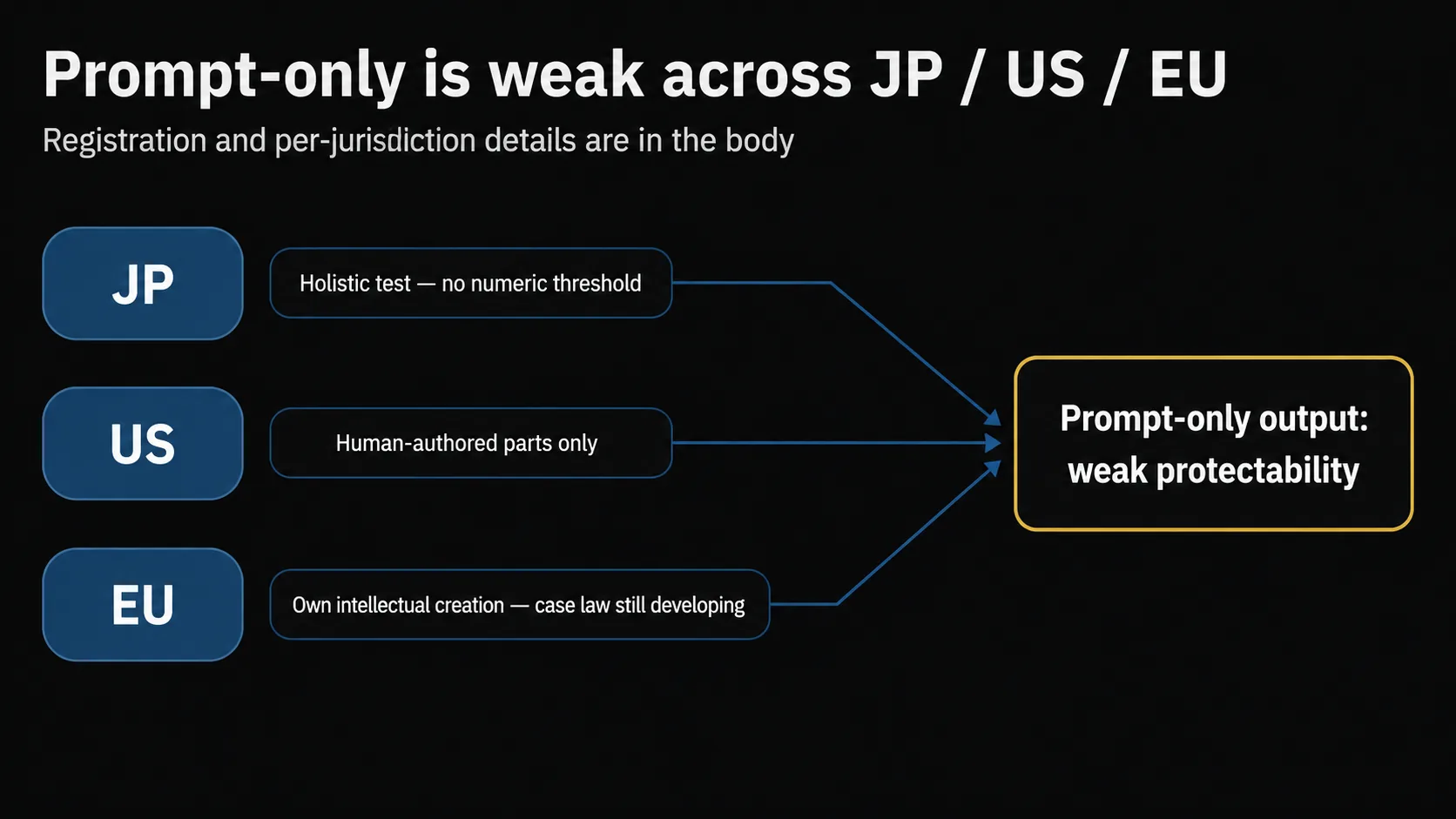
The shared starting point is simple. In both the US and the EU, output produced by a prompt alone — with no human selection or editing — leans toward not being copyrightable. The differences lie in where each system draws the line for "human creation" and in registration. (What follows is a snapshot as of May 2026; the EU side in particular is fluid.)
United States — register only "the part a human made"
The US has a registration system run by the U.S. Copyright Office (USCO), and for AI-assisted work you apply by identifying only the human-authored portion — your selection, coordination, and arrangement (SCA). In a January 2025 registration ("A Single Piece of American Cheese," Invoke AI), the scope of protection was limited to the SCA elements rather than extending without limit to the AI-generated portions.
On authorship, Thaler v. Perlmutter settled, for that case, that an AI cannot be registered as the sole author. The D.C. Circuit so held, and the Supreme Court denied certiorari in March 2026, leaving the ruling in place for that matter. But this is not a merits decision on the broader question — it does not resolve the copyrightability of AI-assisted work where a human did contribute. (It is a distinct matter from the patent case Thaler v. Vidal.) How much the quantity and quality of prompts bear on human authorship is the question in Allen v. Perlmutter, which as of May 2026 remains pending, with no judgment yet (the status after a government-shutdown-related stay should be re-checked against the docket).
European Union — the "intellectual creation" test, with member-state differences
The EU's test for copyrightability is the "author's own intellectual creation," and lower courts have begun issuing decisions unfavorable to protecting prompt-only output (for example, in Germany). These are individual lower-court decisions, however — not a unified position from the Court of Justice of the EU (CJEU). Read them as "a direction lower courts are starting to apply," not as settled precedent.
On the legislative side, Italy in October 2025 became the first EU member state to write AI-copyright rules into national law (Law n. 132/2025, Art. 25). The provision sets human intellectual creation as a requirement, which reads in the direction of "material generated by AI alone is outside protection," though the precise threshold awaits accumulated case law and case-by-case judgment.
A point easy to miss in EU practice is the difference in copyright transferability member state by member state. In Germany, transfer of copyright during the author's lifetime is in principle prohibited (only licenses are possible); in France, moral rights are perpetual and inalienable. Independently of whether AI-generated work is copyrightable, this structural difference feeds directly into contract design. (Note that the EU AI Act's Omnibus package agreed on May 7, 2026 was adopted in June 2026 (Parliament 16 Jun / Council 29 Jun) but, as of July 2026, still awaits Official Journal publication, so transitional measures around the disclosure duty should be confirmed against the published text; this article stays on copyright ownership and leaves disclosure to a separate layer.)
The shared practical implication across jurisdictions is this: how much, and in what form, you can preserve a human creative contribution is what tips copyrightability in any country. Next, we turn that judgment into a concrete "OK to commercialize?" flow.
The pre-commercialization flow — what changes when the exclusive right is "there / thin"
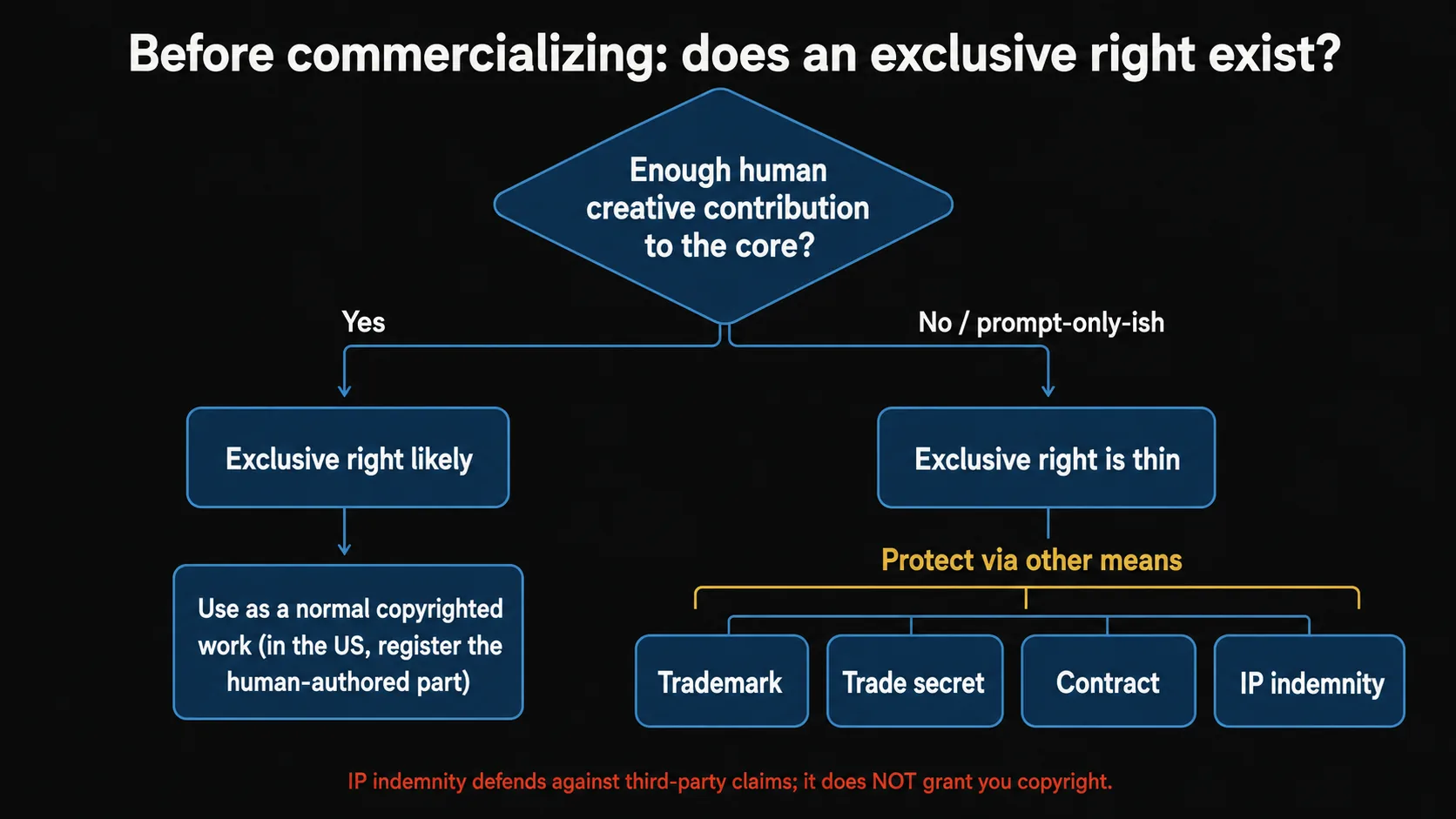
Before commercializing, ask one question: does the core of this work carry your (or your company's) exclusive right? Whether the answer is Yes or No changes your moves.
When the exclusive right is there (the human creative contribution is sufficient), treat it as an ordinary copyrighted work. If it's an important asset in the US, registering the SCA portion carries a real cost in application structure — but for valuable assets it's worth it.
When the exclusive right is thin (close to prompt-only), don't give up on commercializing. Switch to protecting it by means other than copyright.
- Trademark: secure distinctiveness separately as a brand name or logo.
- Trade secret: keep prompt design, parameters, and internal workflow under confidentiality management.
- Contract: set scope of use and exclusivity by agreement with clients and contractors (note that this does not itself create a legal exclusive right).
- Indemnity (IP indemnity): hedge third-party-infringement risk with a provider's indemnity.
The easy trap here is indemnity. IP indemnity is a contractual defense against a third party's infringement claim — it does not guarantee that copyright in the output vests in you. Its reach (covered products and forms of use) also shifts with terms revisions, so the current version needs checking.
A safe-side principle in practice: don't place AI-alone output (prompt-only) at the core of your distinctiveness as-is. Run the core through human selection and editing, and keep AI in a supporting role — that's the shortest route to landing on the "exclusive right exists" side.
The minimum record set — proving later that "I made it"
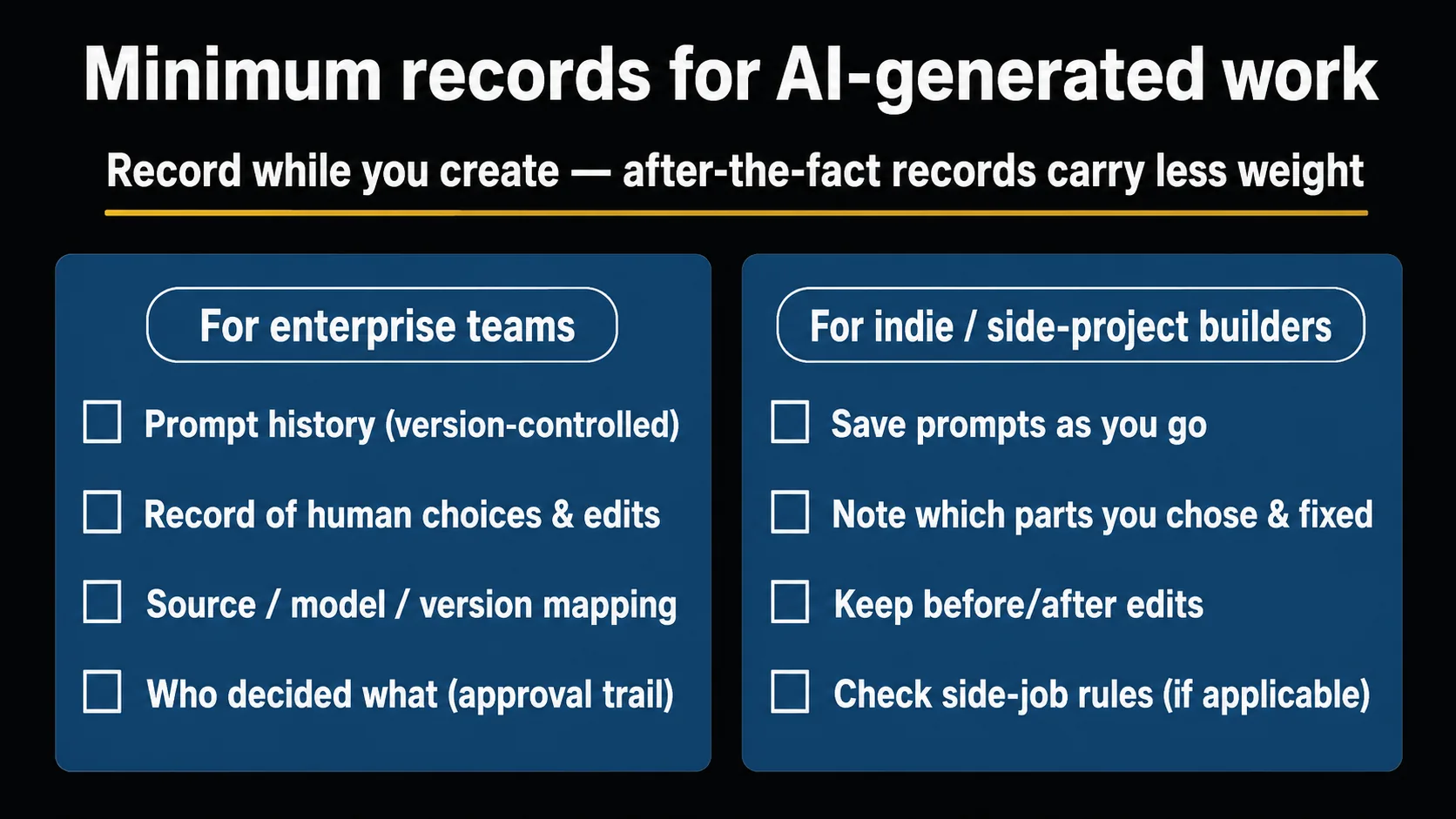
Copyrightability and authorship only get tested once there's a dispute. What works then is contemporaneous records. Records reconstructed after the fact carry less evidentiary weight, so the rule is "keep them as you create." The minimum is simple.
- Prompt history: the instructions you entered and the trial-and-error of regeneration (version-controlled, e.g., with git, where possible).
- Records of human selection and edits: which candidate you chose and where and how you changed it (before/after diffs are strong).
- Mapping between deliverable and source: which materials, model, and version you used (for untangling mixed inputs).
Operations differ a little by jurisdiction. In the US, for an important asset, consider registering the SCA portion, weighing application structure and cost against the benefit. In the EU, account for member-state differences in transfer/license rules and design contract and records as a set. (Many jurisdictions outside the US grant copyright automatically on creation, so registration isn't required there — but preparing evidence is a separate need.)
If you're a solo or side-project builder, don't overthink this. Keep your prompts, and a record of what you chose and edited, at the time you make it — that alone gives you a foundation to later explain "this is my creation."
Wrapping up — a commercialization Go / No-Go checklist by stance
You don't need a "yes" to all of these. Use it as a map to decide, for your stance, where the exclusive right is, what protects it, and what you record.
[Company practice / your organization's AI-generated work]
□ 1. Confirmed there is a human creative contribution (selection / editing) at the core of the work
□ 2. Checked that you haven't placed prompt-only output at the core of your distinctiveness as-is
□ 3. Separated "terms say commercial OK" from "we hold copyright"
□ 4. Considered complementary means (trademark / trade secret / contract / indemnity) where the exclusive right is thin
□ 5. Confirmed the reach and limits of IP indemnity (it does not guarantee copyright vests in you)
□ 6. Set up operations to keep prompt history and human selection/edits at creation time
□ 7. Confirmed jurisdiction-specific points with stakeholders (US = whether to register; EU = member-state transfer rules)
□ 8. Checked you aren't conflating watermarks / provenance (C2PA, invisible watermarks) with copyright ownership

[Solo / side-project work]
□ 1. Can explain, in words, how much of your own selection and editing you added to the output
□ 2. Haven't made the "anyone could get the same output" part the core of your distinctiveness
□ 3. Kept your prompts and "what I chose and edited" at the time you made it
□ 4. Checked it doesn't conflict with your employer's rules / internal policies (for side projects)
It comes down to three things. One: copyright, contract, and disclosure are separate layers — don't conflate them. Two: copyrightability turns on human creative contribution — prompt-only is weak, and that holds in both the US and the EU. Three: even with a thin exclusive right, complementary means and good records can still carry a business. For the contract layer — the terms you read before using a service — see how to read AI service terms. The whole rights picture is fastest to navigate from the hub, the pre-ship rights checklist.
References
Primary sources first (tag (primary) = official documents, statutes, court records, party statements; (supporting) = commentary and reporting). The copyright status of AI-generated work is fluid in both law and case law, so everything reflects what we could confirm as of May 2026. Some primary URLs (court records, official-gazette text) should be confirmed against the source at decision time.
United States
- U.S. Copyright Office — Copyright and Artificial Intelligence (the copyrightability report and the AI-assisted registration practice — registering the human-authored SCA portion) (primary)
- Thaler v. Perlmutter (D.C. Cir. No. 23-5233) (Supreme Court certiorari denied 2026-03-02, No. 25-449, leaving the ruling in place for that matter — an AI cannot be the sole author) (primary)
- Allen v. Perlmutter (pending; no judgment as of May 2026 — bearing on how prompt quantity/quality affects human authorship) (supporting)
European Union
- EU AI Act (Regulation (EU) 2024/1689), Article 50 (the disclosure duty; a separate layer from copyright ownership) (primary)
- EU Council press release, 7 May 2026 — AI Act Omnibus political agreement (adopted June 2026) (Art. 50(2) machine-readable-marking grace period to 2026-12-02) (primary)
- Council of the EU — final adoption of the AI Omnibus (29 June 2026) (primary — final adoption; awaiting Official Journal publication)
- Italy, Law n. 132 of 23 September 2025, Art. 25 (amending Art. 1 of the Italian Copyright Law; published in the Gazzetta Ufficiale on 2025-09-25, in force 2025-10-10 — the first EU member state to enact national AI-copyright rules, setting human intellectual creation as a requirement) (primary; Gazzetta Ufficiale)
- German Copyright Act (UrhG) §29 (no transfer of copyright during the author's lifetime) and French CPI L.121-1 (perpetual, inalienable moral rights) (primary, statutes); German lower-court decisions on the copyrightability of AI output (lower court — not a unified CJEU position) (supporting)
- The EU "author's own intellectual creation" originality standard: Infopaq C-5/08 / Painer C-145/10 / Cofemel C-683/17 (primary — CJEU)
Contract / indemnity
- OpenAI Terms of Use (acknowledges output is not unique / others may receive similar output) / providers' IP-indemnity clauses (e.g., Microsoft Customer Copyright Commitment) — connects to how to read AI service terms (primary; terms text to verify at decision time)
Watermarking / provenance (C2PA and disclosure rules)
- C2PA & Content Credentials Explainer (2.x) (primary — technical standard; it "do[es] not provide value judgments about whether a given set of provenance data is 'true'" and "does not directly address the topic of human or organizational identity" — i.e., it does not decide copyright ownership)
- C2PA Technical Specification (2.x) (primary — technical standard; the creator chooses which assertions to include, and author/copyright fields are optional)
- Google DeepMind — SynthID (primary — provider; an invisible watermark for image / audio / video / text)
- DMCA copyright management information, 17 U.S.C. § 1202 (also at Cornell LII) (falsifying or removing CMI requires acting "knowingly … to induce, enable, facilitate, or conceal infringement") (primary; official U.S. Code)
- California AI Transparency Act — SB 942 as amended by AB 853 (covered-provider provenance and detection duties; AB 853 moved the operative date to 2026-08-02 to align with the EU AI Act) (primary; California Legislative Information)
On AI assistance: This article draws on the author's hands-on experience with the topics, used Claude (Anthropic) as an aid for research, structuring, and summarization, and was then composed after the author verified the primary sources (statutes, government documents, court records, party statements). Because the law and case law here are fluid, the reach of provisions and rulings and their effective dates reflect what was confirmed at the time of writing. Where reliance rests on secondary sources or text that could not be fully confirmed, it is flagged inline and in the references.
About the author
More than 20 years of electrical and software development — from control engineering at a major electronics manufacturer — plus about 10 years of solo development. Across hardware and software, and across enterprise and individual work, I publish the basics that "become a risk if you don't know them," and I plan to cover practical ways to use AI as well. More at About this blog.