
Key Points
- If your contract says nothing, the deliverable's copyright usually stays with the person who made it. In the US, unless the work qualifies as a work made for hire (17 U.S.C. §101), the author owns it — "we paid for it, so it's ours" is wrong. Moving the copyright takes a signed written assignment under 17 U.S.C. §204(a); a purchase order without transfer language and a signature is not enough on its own.
- Who this is for: people hired as indie developers or side-project freelancers (the main audience), and the enterprise practitioners who commission them, in the US or EU. No prior legal knowledge needed.
- What you get: the default rules when the contract is silent (who keeps the rights) + the clause checkpoints for assigning copyright (WMFH, the §204(a) signed writing, moral rights) + trademark screening (USPTO / EUIPO) + a pre-contract checklist for both the hired and the hiring side. Copyright, trademark, and trade secrets are three different regimes; clearing one does not clear the others.
- What's out of scope (for a lawyer / IP specialist or related pieces): whether a specific contract is valid or enforceable / trademark likelihood-of-confusion / the copyrightability of AI output itself (AI-generated content copyright) / output ownership under an AI service's terms (AI service terms).
この記事の要点(日本語版はこちら)
- 契約に何も書かないと、成果物の著作権は作った側に残るのが原則です。本記事は 米国・EU の実務 を主軸にした英語版です。
- 日本法(著作権譲渡の 27/28 条特掲・著作者人格権・フリーランス新法/取適法・商標)を主軸にした解説は 日本語版 にあります(翻訳ではなく対になる記事です)。
Written: 2026-05 / Jurisdiction focus: United States & EU (Japan is covered in the Japanese edition) / last_updated: 2026-05-31 Changelog: 2026-05-31 first published
This article is educational material, not legal advice
Freelance contracts and IP turn on jurisdiction, the contract text, and the facts of each matter. This article is a general educational overview, not legal advice on a specific contract or dispute, and it does not guarantee accuracy, completeness, or currency. Out of scope: whether a specific contract is valid or enforceable, trademark likelihood-of-confusion or office actions, the enforceability of US state non-compete clauses, the copyrightability of AI output itself (covered in copyright in AI-generated work), and output ownership under an AI service's terms (covered in AI service terms). For real decisions, consult a qualified attorney or IP specialist, or your in-house legal team. The information is provided "AS IS," and neither the author nor YATA-NODE accepts any liability for loss or damage arising from its use or reliance on it. Use it at your own risk.
About this series: this is the closing piece in the "rights for builders" series. The hub is The Pre-Ship Rights Checklist; related pieces cover other people's code in Reading OSS licenses, acquiring sites and data in The legal boundaries of scraping, and external assets in Licensing images, music, and fonts. A Japanese edition centered on Japanese law sits at 日本語版. Each piece reads on its own.
A few terms (for newcomers):
- Independent contractor: hired outside an employment relationship. Because it is not employment, the employer-ownership rules that apply to employees generally do not apply by default — the copyright tends to stay with the contractor unless the contract says otherwise.
- Work made for hire (WMFH, 17 U.S.C. §101): the US mechanism where the hiring party is the author from the start. Two routes: ① a work prepared by an employee within the scope of employment, or ② one of nine enumerated categories of commissioned work, agreed in a signed writing as a work made for hire. For independent contractors, route ② is the gate; if it does not apply, you need a written assignment instead.
- Written assignment (17 U.S.C. §204(a)): a transfer of copyright ownership is not valid unless it is in writing and signed by the owner. A purchase order that lacks transfer language and a signature is not enough on its own.
- §203 termination right (US): for post-1978 transfers, the author or heirs may terminate the grant during a five-year window beginning 35 years after the grant (a separate calculation applies where the grant covers the right of publication), on prior written notice (this does not reach WMFH). It cannot be waived in advance.
- Moral rights: rights such as attribution and integrity. In Germany and France these are treated as inalienable; contracts handle them through waivers of exercise or license terms, with limits.
- German UrhG: under German copyright law the copyright itself is inalienable (cannot be transferred, except by inheritance); practice grants licenses of exploitation rights (Nutzungsrecht) instead.
- Trademark (USPTO / EUIPO): protection for business and product names — a separate system from copyright, with its own offices and databases.
What happens if the contract says nothing — the default rules (US / EU)
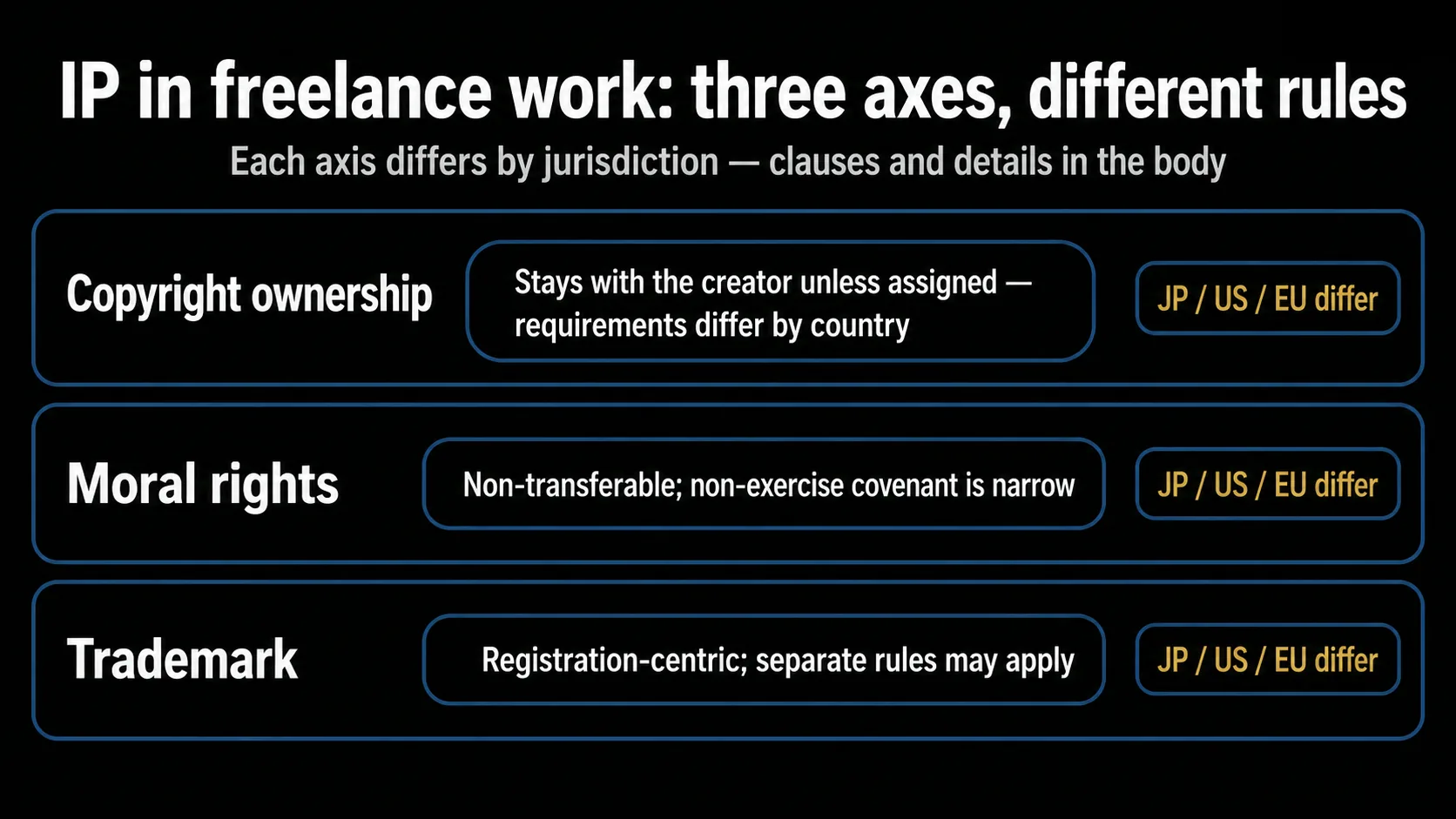
The first principle: agreement overrides the legal default. Put the other way around — if you don't write it down, the legal default applies, and the default is not always "favorable to the hiring side."
- United States: copyright vests in the author by default. The hiring party is the author from the start only when the work qualifies as a work made for hire — one of the nine enumerated categories plus a signed written agreement (or an employee within the scope of employment). Otherwise, for the hiring party to acquire the copyright, a written assignment under 17 U.S.C. §204(a) — in writing, signed by the owner — is required. The standard for distinguishing an employee from an independent contractor was set in CCNV v. Reid, 490 U.S. 730 (1989).
- European Union: there is no single rule, and member-state differences are large. Germany makes the copyright itself inalienable (it cannot be transferred, except by inheritance) and works through licenses of exploitation rights. France treats moral rights as perpetual and inalienable. The Netherlands allows assignment by a written deed. Which law governs decides the outcome, so cross-border work has to fix governing law and the rights treatment together.
The shared conclusion is simple: "saying nothing = safe in any jurisdiction" is false. In particular, the assumption that "we paid to have it made, so of course it's ours" is dangerous on both sides of the Atlantic. The next section narrows down what to actually write into the contract.
Copyright and moral rights — three checkpoints for the clauses
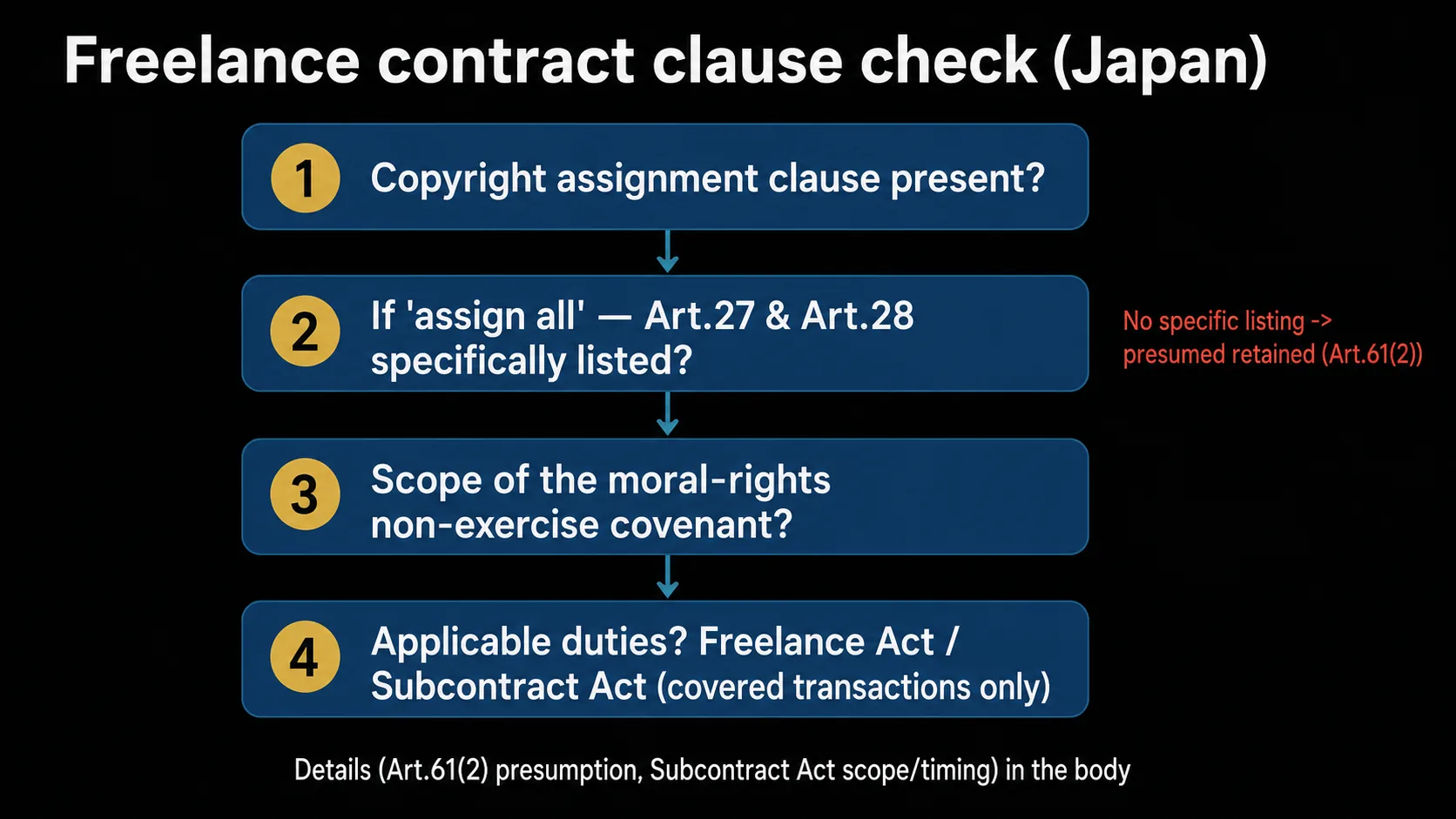
Once you decide to move or protect rights, three things typically go into the contract.
Checkpoint 1 — Spell out the scope of transfer (US: a signed writing under §204(a))
In the United States, for a deliverable that is not a work made for hire, the hiring party acquires the copyright only through a written assignment under 17 U.S.C. §204(a) — in writing and signed by the owner. A purchase order that lacks both transfer language and a signature is not enough on its own; the transfer has to be a signed writing that actually conveys the copyright. On top of that, the §203 termination right (for post-1978 transfers other than WMFH, exercisable during a five-year window beginning 35 years after the grant, on prior written notice, and not waivable in advance) means "assigned once, safe forever" is not guaranteed either.
The EU depends on governing law. In Germany, you cannot assign the copyright at all — practice grants licenses of exploitation rights instead — so the very idea of an "assignment clause" may not work, and you draft the license scope (exclusive/non-exclusive, territory, term, media) carefully. On cross-border matters, decide governing law and the rights mechanism together.
Hiring side's check: don't leave it at "all rights assigned." For US work, confirm a signed written assignment that conveys the copyright; for EU work, confirm governing law and whether assignment is even possible (in Germany, draft the license scope instead).
Checkpoint 2 — Decide how moral rights are handled
Moral rights cannot simply be bought. In Germany the copyright as a whole is inalienable, and in France moral rights (CPI L.121-1) are treated as perpetual, inalienable, and not subject to limitation — a blanket contractual waiver is generally treated as ineffective. So in the EU you cannot assume a clean "waiver of all moral rights"; you negotiate the scope of permitted modification through license terms instead.
In the United States, general moral rights are narrow — the Visual Artists Rights Act (VARA) reaches only a limited class of fine art, not most commissioned software, design, or copy. So for typical builder deliverables, US practice manages attribution and modification through contract terms rather than a statutory moral-rights regime.
Hiring side's check: if you plan to modify or build on the deliverable, write the permitted scope (modify, adapt, crop) concretely. For EU work, do not assume moral rights can be waived; secure the modification rights through the license.
Checkpoint 3 — For US work, decide whether to use WMFH structurally
For US work, if the deliverable fits one of the nine WMFH categories and you have a signed written agreement, the hiring party is the author from the start and the result is outside the reach of the §203 termination right (useful for long-term certainty). But standalone software and a standalone logo are typically not within the WMFH categories, and whether a work qualifies can turn on its use and where it is incorporated — so it is a use-by-use judgment. "Write 'work made for hire' and it's automatically so" is false; where it does not apply, you build the deal on a §204(a) assignment instead.
Get these three right and it becomes easier to put into words "who gets what right, and how far it moves." Note that copyright and moral rights are only one regime — trademark is separate, which the next section turns to.
Business and product names — trademark screening (US / EU)
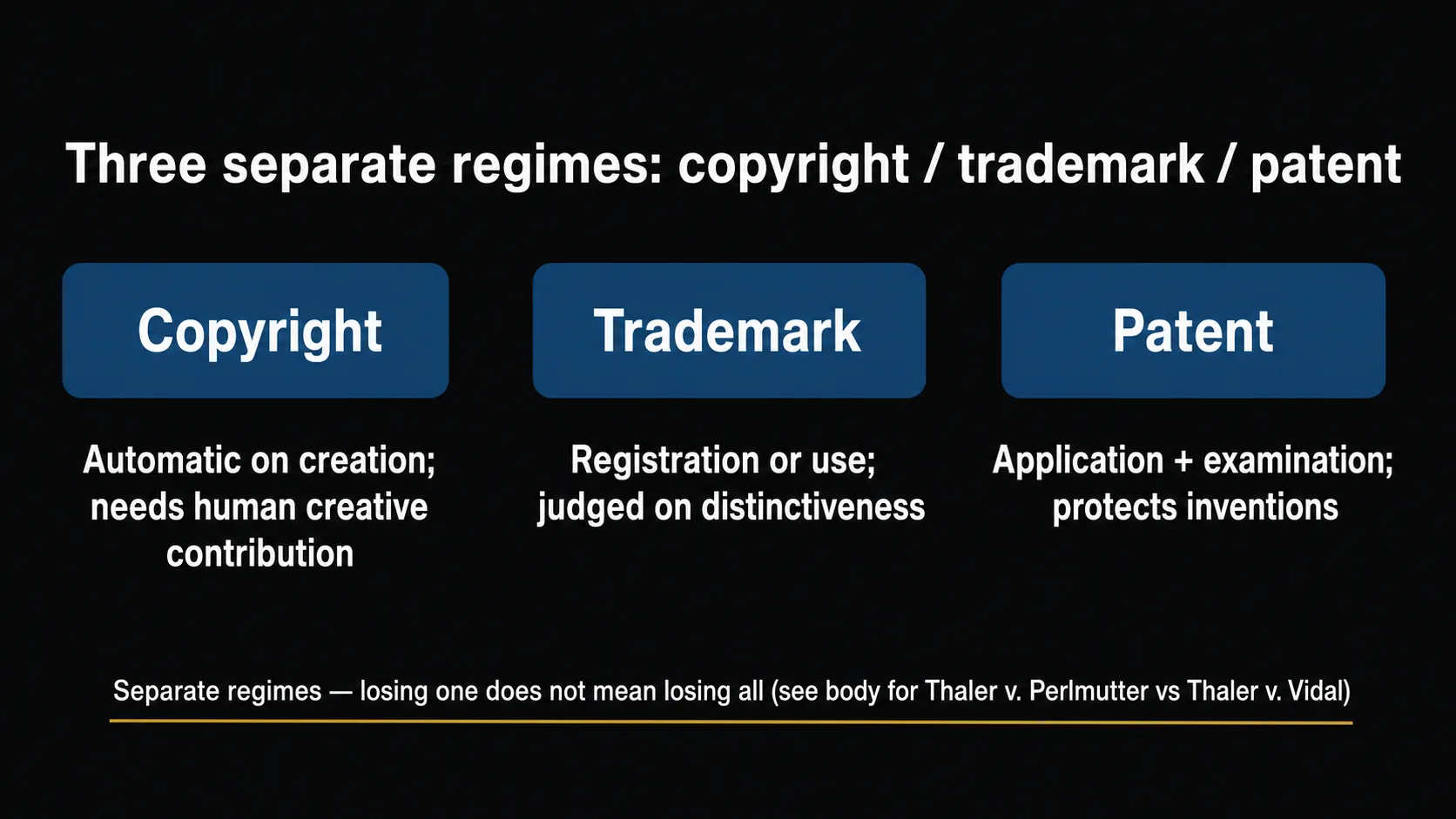
First, clear up a common confusion. Copyright, trademark, and patent are different regimes. Even where copyright does not protect something, a business or product name may be protectable as a trademark — and a name's trademark status is judged independently of whether the underlying graphic attracts copyright. (As a vivid illustration that the regimes are distinct: in the US, Thaler v. Perlmutter is a copyright matter and Thaler v. Vidal is a patent matter — the same plaintiff, decided under separate statutes by separate courts. He happened to lose both, on the AI-authorship/inventorship point; the takeaway is that each regime is judged on its own terms, so a result in one does not automatically carry over to another.)
Screening by jurisdiction:
- United States: trademark rights are essentially use-based. Even without a federal registration, if you can prove use in commerce, common-law (state) rights can arise within that area; unregistered marks used in commerce can also be enforced federally for false designation of origin under Lanham Act §43(a) (15 U.S.C. §1125(a)) — and conversely, rights are weak where you are not using the mark. Before adopting a name, search the USPTO Trademark Search system (formerly TESS, retired Nov. 30, 2023) for prior and confusingly similar marks as a first screen.
- European Union: an EU trademark (EUTM) at the EUIPO covers the whole EU in a single filing, but you must put it to genuine use within five years of registration — after that grace period, an unused mark becomes vulnerable to revocation for non-use (EUTMR 2017/1001, Arts. 18 & 58). Search the EUIPO database (eSearch plus, TMview) before filing.
One more contract-side trap. Signing an NDA does not, by itself, make your information legally protected as a trade secret. Trade-secret protection generally requires that the information actually be kept secret through reasonable measures, that it have value, and that it not be generally known — under the US Defend Trade Secrets Act / the Uniform Trade Secrets Act, and in the EU under the Trade Secrets Directive (2016/943). "Wrote it in the contract" and "protected by law" are different — the same shape as trademark being separate from copyright.
Wrap-up — a pre-contract checklist (hired side / hiring side)
You don't need a "yes" on every line. This is a map for taking home "what to agree, in which jurisdiction, and how" from your own position.
[Hired side (indie developer / side-project freelancer)]
□ 1. Agreed whether you transfer copyright by assignment or grant a license instead
□ 2. For US work, confirmed any transfer is a signed writing that actually conveys the copyright (§204(a))
□ 3. Set the concrete scope of permitted modification (modify / adapt / crop); for EU work, did not assume moral rights are waivable
□ 4. Confirmed the fee and payment terms are stated in writing
□ 5. Screened your business / product name in the USPTO (US) and EUIPO (EU) databases
□ 6. If AI-generated material is mixed into the deliverable, separately checked its copyrightability (see the AI-output piece)
□ 7. Did not rely on an NDA alone — kept actual secrecy measures in mind (a trade secret needs more than a contract)

[Hiring side (enterprise practitioner)]
□ 1. Went beyond "all rights assigned": for US, a signed written assignment (§204(a)); for EU, governing law and whether assignment is even possible
□ 2. Made the modification scope concrete to match your plans (in the EU, do not assume moral rights can be waived)
□ 3. For US work, judged WMFH eligibility use-by-use (standalone software / logos are typically not within the nine categories)
□ 4. Confirmed any required disclosures and payment terms under the governing jurisdiction's freelance / fair-dealing rules
□ 5. Confirmed the deal does not rely on a bare purchase order to move copyright
Three axes hold it together. ① Agreement overrides the legal default — say nothing, and the copyright stays with the maker. ② Copyright, moral rights, trademark, and trade secrets are different regimes — clearing one does not clear the others. ③ "Written into the contract" and "protected by law" are different — a §204(a) signature, genuine use, and reasonable secrecy measures each change the result. Where commissioned deliverables mix in AI-generated material, the copyrightability question is its own topic; the overall map lives in the hub, The Pre-Ship Rights Checklist.
References
Primary sources first ((primary)= statutes / official databases / court documents / government materials; (secondary)= commentary). Law and practice move, so all of this reflects the state at the time of writing (2026-05).
United States
- 17 U.S.C. §101 — Definitions ("work made for hire")(primary)
- 17 U.S.C. §201 — Ownership of copyright(primary)
- 17 U.S.C. §203 — Termination of transfers(primary)
- 17 U.S.C. §204(a) — Execution of transfers (signed writing)(primary)
- 17 U.S.C. §106A — Rights of attribution and integrity (VARA)(primary — Cornell LII)
- Community for Creative Non-Violence v. Reid, 490 U.S. 730 (1989) — the employee / independent-contractor test for WMFH(primary — Cornell LII)
- USPTO — Trademark search and basics(primary)/ Lanham Act §43(a) (15 U.S.C. §1125(a)) — unregistered-mark / unfair-competition claims(primary — Cornell LII)
- Defend Trade Secrets Act (18 U.S.C. §1836 et seq.)(primary)
- Thaler v. Perlmutter (copyright, D.C. Cir.) and Thaler v. Vidal (patent, Fed. Cir.) — separate matters illustrating regime separation(primary — court documents)
European Union
- German Copyright Act (UrhG) §29 (inalienability) / §31 (exploitation rights)(primary — Gesetze im Internet)
- French Intellectual Property Code, CPI L.121-1 (perpetual, inalienable moral rights)(primary — Légifrance)
- Dutch Copyright Act (Auteurswet) Art. 2 — assignment by a written deed(primary — wetten.overheid.nl)
- EU Trade Mark Regulation (EU) 2017/1001 — Art. 18 (genuine use) / Art. 58 (revocation for non-use)(primary — EUR-Lex)
- EUIPO — EU trademark and genuine use(primary)
- Directive (EU) 2016/943 — Protection of trade secrets(primary — EUR-Lex)
On AI assistance: this article was built from points the author already worked with, using Claude (Anthropic) to help research, organize, and distill, after which the author confirmed primary sources (statutes, court documents, and the official trademark databases). Freelance contracts and IP move with legal reform and practice, so the statutes, cases, and dates reflect the state at the time of writing (2026-05). Any point resting on a secondary source is tagged (secondary) in the references.
About the author
More than 20 years of electrical and software development — from control engineering at a major electronics manufacturer — plus about 10 years of solo development. Across hardware and software, and across enterprise and individual work, I publish the basics that "become a risk if you don't know them," and I plan to cover practical ways to use AI as well. More at About this blog.