
One trick for getting stable output from AI is, maybe surprisingly, to use AI as little as possible. It's something you tend to feel with a small model — an SLM, a Small Language Model.
Ask AI the same question and you'll get a slightly different answer almost every time. That's not moodiness; it runs probabilistically, so structurally it can't be avoided. Which is exactly why, for work where you want stable output, it pays to narrow AI's role to only the parts that truly need it.
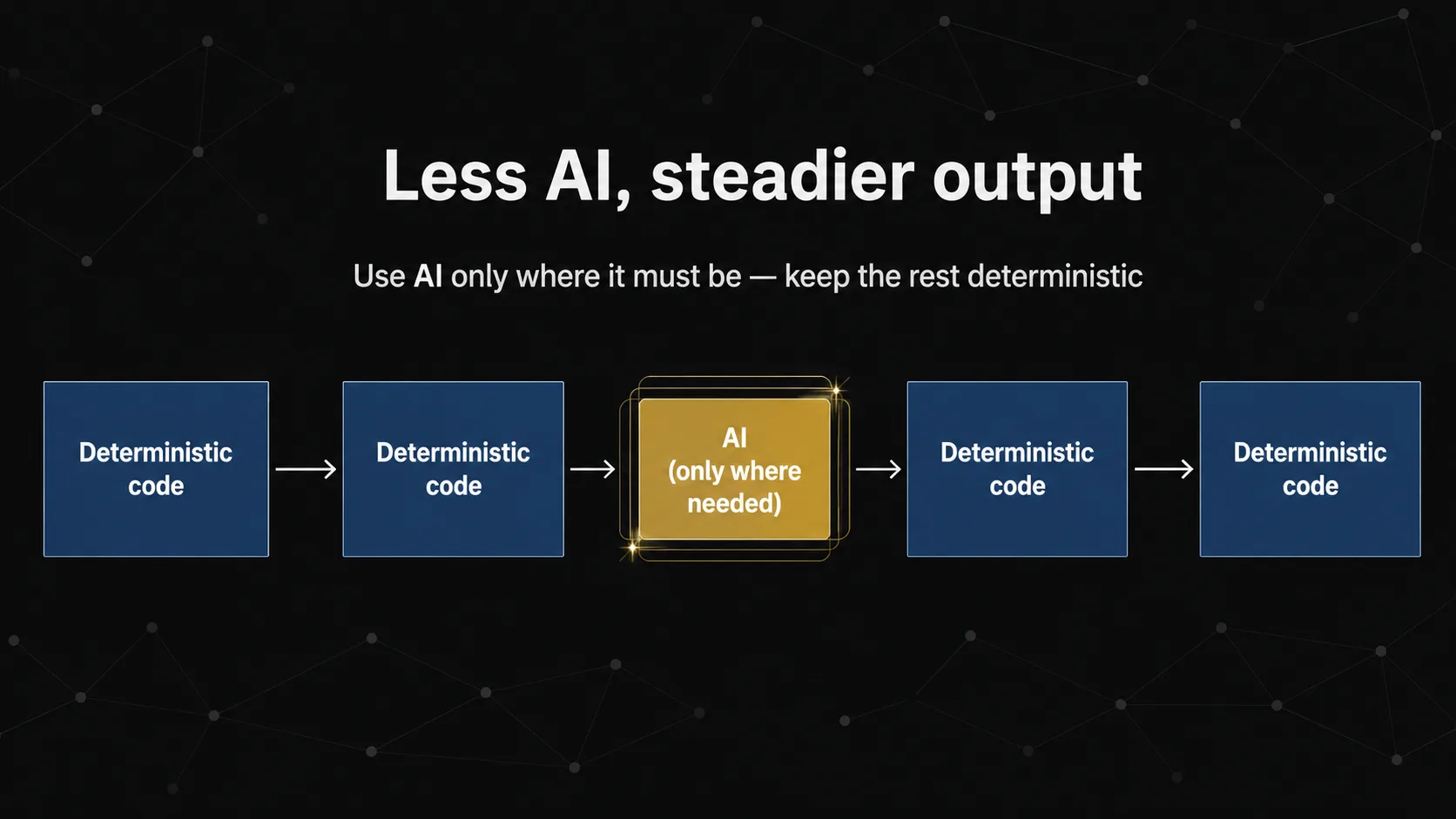
For example, when you turn a task's steps into a Skill, hand AI only the parts that genuinely need its judgment, and for the rest just ask it to "write the program for this part." That part then behaves the same way for the same input, which holds down the variation in the output as a whole. The idea is to bracket AI's probabilistic behavior with deterministic processing.
When you want ideas, or room for the unexpected, you don't need this — the probabilistic wobble is an asset there. But when you want a fixed business flow handled the same way every time, it's a way of thinking that earns its keep.