
⚠ This area moves by the day — pricing, plan requirements, and regional availability change constantly. Use this article as a guide for narrowing down the options, and always confirm the official primary sources (official docs and the latest announcements) right before you adopt anything.
Key Points
- There are many ways to run Claude, but the deciding factor is what you want to do: approval-only, full control, autonomous batch, or employee rollout each fit a different place. We map nine options onto four zones and narrow to one.
- Who this is for: individual developers who want to use their local Claude Code from outside, and practitioners planning a team rollout. Setting security aside (its principles are covered in communication security and virtualization and sandboxing), the right place also shifts with reach — how far across the org you want adoption to go: a chat UI to simply broaden access, a Web or Desktop app to step it up, or the CLI / an IDE extension (e.g. VS Code) to reach power users, since few are CLI-fluent. No prior knowledge assumed.
- What you get: the ability to narrow to one option by use case, budget, and data requirements — plus, the part this English edition centers, why deployment is increasingly a compliance and data-residency decision (HIPAA, FedRAMP, EU/US sovereignty), not only a technical one. The single most consequential trap: Claude Platform on AWS runs inference on Anthropic's own infrastructure (outside the AWS security boundary) and is not HIPAA-ready — regulated workloads belong on Amazon Bedrock.
- This is a companion to the Japanese edition, not a translation. The technical core (the four zones, the nine candidates) is shared; the Japan-residency framing there becomes a US/EU compliance framing here.
Written: 2026-06 / Scope: individual developers wanting remote access to local Claude Code, and practitioners planning a team rollout / last_updated: 2026-06-13 Changelog: 2026-06-13 initial version
This is an educational overview, not procurement or compliance advice
Claude's remote features and cloud availability are the fastest-moving area — release dates, pricing, plan requirements, and supported regions shift frequently. Use this article as a map for narrowing the candidates, and verify against primary sources (official docs and the latest announcements) right before you actually adopt anything. Every date, version, price, and region here is a snapshot at publication (2026-06) and is provided without warranty of accuracy, completeness, or currency. If you reached this article through search some time later, assume parts may already be out of date. Before adopting, confirm pricing, plan requirements, and data-residency eligibility in particular against each service's official docs and latest announcements. This content is provided "AS IS"; the author and YATA-NODE assume no liability for any damages arising from its use.
Where this fits: this article is about where to run / how to remotely use the Claude Code environment you've built. Read it alongside Enterprise Networking (the ground your execution sits on), Communication Security (securing remote access), Virtualization & Sandboxes (isolation strength), and Choosing an IaC Tool (managing the upstream infrastructure). Each reads independently.
Quick terms: Deployment target / execution location — the machine where the Claude Code process, or the app that calls it, actually runs (your PC, a VPS, a cloud, or Anthropic's servers). Inference — the model's actual computation; where inference runs decides where data is processed (data residency). Data residency — keeping processed data within a specific country or region; for regulated workloads this can be a hard legal requirement. OAuth vs API key — two ways to authenticate; some Claude features accept only one, which ties directly into plan requirements (shown in the tables). PTY (pseudo-terminal) — the terminal relay that approval-forwarding tools depend on; environments without a PTY can't run them. VPS — a virtual server rented in the cloud (from a few dollars/month) to keep your own tool always on. ngrok — a tunnel that temporarily exposes your local PC to the internet (free tier available). MFA — multi-factor authentication: confirming identity with a factor beyond your password.
First, the map — it splits on where it runs × where data is processed × who operates it
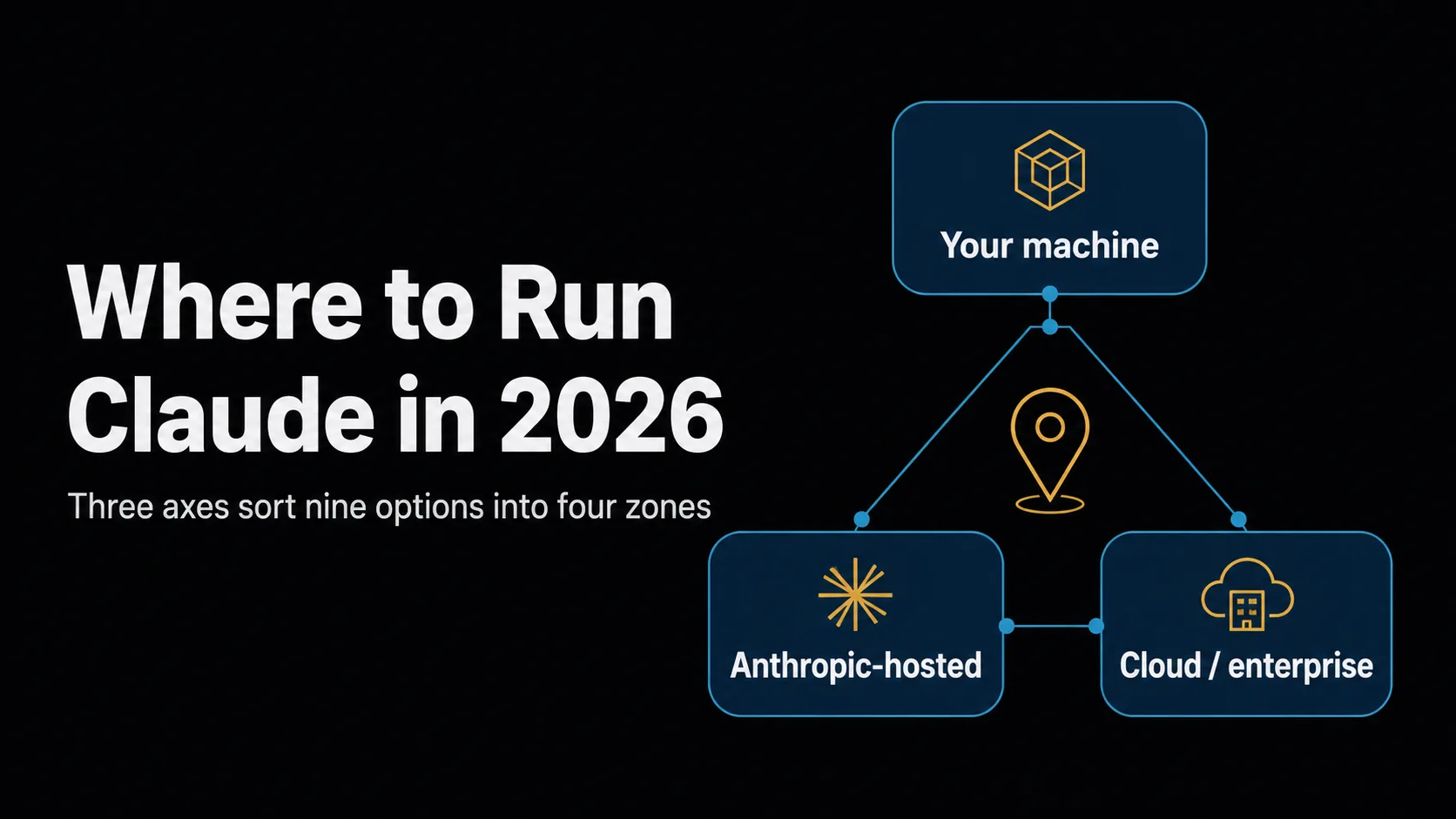
Here's the conclusion first. There are many ways to run Claude, but only three axes matter:
- Where it runs — your PC, a VPS, a cloud, or Anthropic's servers.
- Where data is processed — where inference actually happens. If you must keep data in a specific country or region, this is the decider.
- Who operates it — you, a cloud vendor, or Anthropic.
Sorting the nine candidates (A–I) by these axes yields four zones. A map makes it all legible at once.
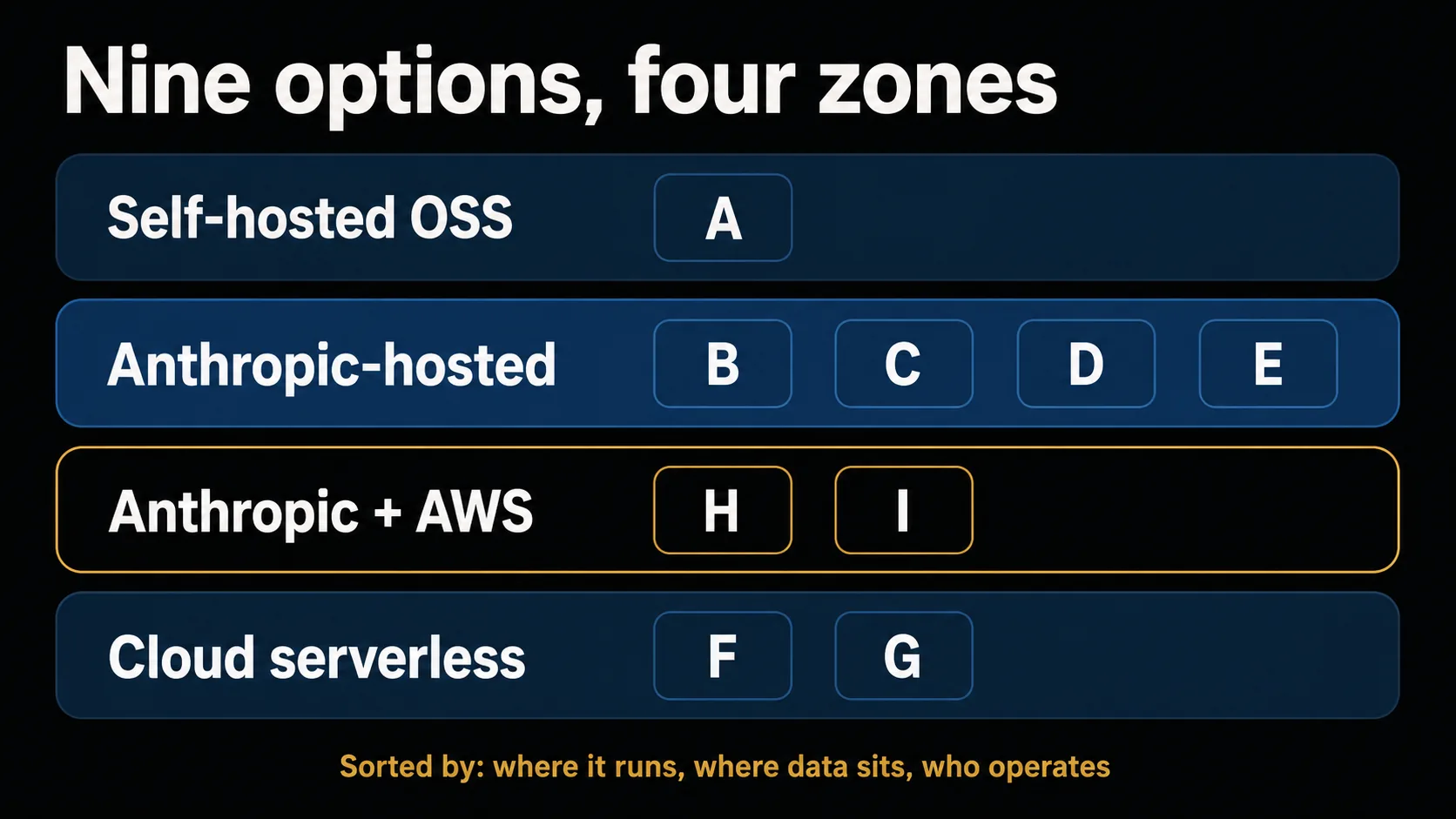
| Zone | Candidate | One-liner | Where it runs | Where your session data sits | Who operates |
|---|---|---|---|---|---|
| Self-hosted OSS | A claude-approval-server | forwards just the approval dialog to your phone (an OSS the author publishes) | your PC | you | you |
| Anthropic-hosted | B /dispatch | submit a new task from your phone; a Desktop app runs it | Desktop-running PC | Anthropic | Anthropic |
| Anthropic-hosted | C /remote-control | drive your local session in full from outside | local PC | local (only traffic goes via the Anthropic API) | Anthropic |
| Anthropic-hosted | D Managed Agents | fully autonomous execution in the cloud (API) | Anthropic cloud | Anthropic | Anthropic |
| Anthropic-hosted | E Claude API direct | call the model from your own backend, minimal setup | yours + Anthropic | Anthropic (model only) | you + Anthropic |
| Cloud serverless | F VPS / Cloud Run self-host | run your own tool in the cloud, always on | VPS / container | you | you |
| Cloud serverless | G managed AI agent | Bedrock / Vertex / Foundry execution environments | each cloud | the cloud vendor | cloud + Anthropic |
| Anthropic + AWS hybrid | H Claude Platform on AWS | AWS auth/billing + Anthropic-native features | Anthropic's own infra | Anthropic (outside AWS) | AWS + Anthropic |
| Anthropic + AWS hybrid | I Claude for Enterprise on Marketplace | UI-inclusive employee SaaS via a Marketplace contract | Anthropic's own infra | Anthropic | Anthropic |
On inference vs. session data: that column shows where your session, files, and logs sit. The model inference itself is separate — for A through F it runs on your chosen provider (Anthropic by default), so prompts and model outputs travel to that provider over TLS even when execution is local (per Claude Code's data-usage docs). Where inference runs only becomes a variable you select in the cloud zone (G/H/I) — via
inference_geoor region. (A is the exception that proves the rule: it relays only the approval dialog, while the model call happens in your own separate Claude Code session.)
A note on terms: "Claude's servers" (Anthropic-hosted B/C/D, or E which only calls the model) and "general cloud serverless" (borrowing AWS/GCP/Azure infrastructure, F/G) look alike but differ. The former is Anthropic's responsibility boundary; the latter is you using a cloud vendor's platform. This article keeps that line clear and splits recommendations by use case.
Below we go from the individual developer's choices (use your own machine → official remote features) to team/enterprise rollout (cloud and enterprise platforms) last.
Use your own machine — self-hosted OSS and self-hosting
This zone is the lightest and the only one with no monthly fee. It fits people whose work is done on the PC but who want to handle approvals from outside, or who don't meet a plan requirement / want to stay at $0/month.
A. claude-approval-server (forward just the approval to your phone)
A is an OSS the author (YATA-NODE) publishes. It forwards only Claude Code's approval dialog to your PC terminal and your phone (or a PC browser); answering on either side auto-dismisses the other. Approval requests from multiple projects collect on one phone screen.
- Cost: ngrok's free tier + your Claude Code usage = effectively $0/month to start.
- Good when: pressing approve from outside is enough / you don't want a subscription / you want to keep it self-contained.
- Tunnels for exposure: besides the default ngrok, for persistent use a Cloudflare Named Tunnel + Access (a custom domain, with MFA, at no extra cost) or, if you already run Tailscale, Tailscale Funnel (available on all plans including the free Personal tier, per the official docs).
- Security: the server binds to 127.0.0.1 and is only reachable through the tunnel; every API call requires a token (with timing-attack-safe comparison), plus rate limiting and an injection allowlist.
Where self-hosted OSS and the official Channels overlap (as of 2026-06)
Anthropic's official Channels has arrived (a research preview on Claude Code v2.1.80+, authenticated via claude.ai or a Console API key, supporting Telegram / Discord / iMessage), and it overlaps with self-hosted OSS for the "push messages/events into a running session from outside" use case. But the two are designed differently.
- Official Channels = "push events + chat bridge." CI results or chat messages flow into a running session and Claude replies. Remote approval of a permission prompt is possible only when a channel declares the permission-relay capability.
- A (claude-approval-server) = specialized in remotely forwarding the approval dialog. Its purpose is to handle approvals safely.
If you just want notifications and a light back-and-forth, official Channels may be enough. If you specifically want to handle approvals reliably and self-hosted — or to use an auth shape Channels doesn't cover — a setup like A still has its place. Both require keeping a running session open (tmux / a background process).
F. Self-host on a VPS / Cloud Run / Fly.io
If you want to keep things running 24/7 even with your PC closed, put your own tool in the cloud. A VPS runs around $5/month; Cloud Run / Fly.io start on a free tier.
- The pitfall (important): AWS Lambda and Cloudflare Workers have no PTY, so tools that need a pseudo-terminal (like approval forwarding) won't run (Lambda caps at a 15-minute timeout; Workers don't support child-process spawning). Container platforms (VPS / Cloud Run / Fly.io / Render) are the realistic answer.
- Good when: you want full control over your host, session, and files / you need always-on / you have the operational know-how. (Note: the model inference still runs on your chosen provider — Anthropic by default — unless you self-host an open model, so "sovereignty" here covers your runtime and data-at-rest, not the inference itself.)
Run it through Anthropic's hosted remote features
Instead of building your own setup, use Claude's official features to work from outside. The four are not competitors but different layers, so pick the one that matches your use. Compare the release, plan, billing, and constraints below (all as of 2026-06).
| Candidate | What it does | Release / version | Plan requirement | Billing | Main constraint |
|---|---|---|---|---|---|
| B /dispatch (Cowork) | submit a new task from your phone; a Desktop app runs it | research preview (beta) | Pro / Max (not Team/Enterprise), no API key | within your plan | Desktop-running PC must stay awake (macOS / Windows x64); both the Desktop and mobile apps required |
| C /remote-control | drive your local session in full from outside | Claude Code v2.1.51+ (research preview) | Pro / Max / Team / Enterprise, no API key (OAuth required) | within your plan | Team/Ent admins must enable it; up to 32 sessions |
| D Managed Agents | fully autonomous execution in the cloud | April 2026 (beta; header managed-agents-2026-04-01) | API key required (enabled by default for all API accounts) | token billing + $0.08 / session-hour | you build the UI; beta stage |
| E Claude API direct | model calls + your own agent loop | existing (since the API launched) | API tier, API key | token billing (Opus 4.8 = $5 / $25 per MTok in/out) | you implement the UI and state yourself |
Put plainly:
- Throw a new job from outside and just collect the result → B /dispatch (for those who can keep a Desktop-running PC awake; you submit from the mobile app).
- Sit down and operate Claude Code from outside → C /remote-control (for those who meet the plan requirement; it can't be called with an API key, OAuth is required).
- Run large-scale parallel / autonomous batches in production → D Managed Agents (Anthropic handles the infrastructure).
- Embed the model in your own service → E Claude API direct (the most flexible, but you build the UI and the agent loop yourself).
The OAuth-vs-API-key line: B / C are OAuth only (no API key), while D / E require an API key. Anthropic draws this line deliberately between "features behind an interactive UI" and "programmatic execution," and it directly shapes your plan choice.
Cloud & enterprise platforms — data residency and compliance
This is the zone you reach for on a team rollout or when integrating with an existing cloud contract. Where data is processed — who operates the inference — becomes the deciding factor, and for regulated industries it decides everything.
| Candidate | Inference operated by | HIPAA | FedRAMP | EU residency |
|---|---|---|---|---|
| G Bedrock | AWS | ◯ HIPAA Eligible (AWS BAA covers; PHI stays in Bedrock) | ◯ High + DoD IL4/IL5 (GovCloud, 2025-05-23) | ◯ EU geography profile + EU regions |
| G' Vertex AI | △ BAA scope to confirm per case | ◯ High + IL-2 (Assured Workloads, 2025-04-02) | ◎ eu multi-region / regional EU | |
| G'' Microsoft Foundry | Anthropic's own infra | ⚠️ not stated | △ not explicitly confirmed | △ Sweden Central at best; EU-native is a "2026 goal," unconfirmed |
| H Claude Platform on AWS | Anthropic's own infra | ✕ HIPAA-ready not available (officially stated) | ✕ (regulated industries are pointed to Bedrock) | ✕ (inference_geo is us/global only) |
The takeaways:
- G. Managed AI agent: AWS Bedrock AgentCore (Code Interpreter GA 2025-10-13, sessions up to 8 hours) / GCP Vertex AI Agent Engine (Code Execution centered on
us-central1) / Microsoft Foundry (East US2, Sweden Central). For compliance, AWS Bedrock GovCloud holds Claude's FedRAMP High + DoD IL4/IL5 authorization (announced 2025-05-23), and Vertex AI (Assured Workloads) holds FedRAMP High + IL-2 (2025-04-02) — these two are the public-sector paths. The design is an "LLM sandbox," so it's a poor fit for a human-in-the-loop approval server. - H. Claude Platform on AWS (GA 2026-05-11, 17 auth-endpoint regions): you keep AWS IAM (SigV4), consolidated billing, and CloudTrail, while inference is operated directly by Anthropic. Same-day-ish access to Anthropic-native features (Skills / MCP / Managed Agents) is the draw — but see the compliance note below.
- I. Claude for Enterprise on Marketplace (2025-07-15 listing): Claude Code (terminal agent) + Claude via web/mobile/desktop + SSO / SCIM / audit logs, delivered as a UI-inclusive SaaS. The 25-seat minimum makes it a poor fit for small teams. Like H, inference runs on Anthropic's infrastructure (outside the EU Data Boundary).
The compliance trap: Platform on AWS is not HIPAA-ready — regulated workloads belong on Bedrock
The single most consequential procurement trap is mistaking Claude Platform on AWS for a compliance-grade path because it runs "on AWS." It doesn't run inference on AWS. Anthropic's own docs are explicit:
"Organizations in regulated industries that require FedRAMP High, IL4, IL5, or HIPAA-ready compliance ... should use Claude in Amazon Bedrock." (Claude Platform on AWS docs, "When to choose Bedrock," retrieved 2026-06-13)
And the same docs list, under "Features not supported," that Anthropic's HIPAA-ready program is not available on Claude Platform on AWS. (Two different things share the word "HIPAA": HIPAA-ready is Anthropic's compliance program — offered on the first-party API and the Bedrock path, not on Platform on AWS — while a HIPAA Eligible Service is AWS's classification for services like Bedrock that may handle PHI under an AWS BAA. The assurance comes from different parties, which is exactly why inference operated by AWS clears HIPAA while inference operated by Anthropic does not.) The reason is structural: on Platform on AWS, inference_geo accepts only us or global, and inference runs on Anthropic's own infrastructure, outside the AWS security boundary. AWS PrivateLink protects the VPC-to-AWS-endpoint hop, but the request then leaves AWS to reach Anthropic. So:
- US regulated → Bedrock, but split by requirement: HIPAA is covered by commercial Bedrock + an AWS BAA (GovCloud is not required — Bedrock is an AWS HIPAA Eligible Service); FedRAMP High / DoD IL4 / IL5 require Bedrock GovCloud (2025-05-23). Vertex AI (Assured Workloads) is the GCP alternative for FedRAMP/IL. Platform on AWS and Foundry fall out.
- EU data residency → Vertex AI (
eumulti-region / regional) or Bedrock (EU geography profile). Claude Platform on AWS does not support EU residency. Note that AWS European Sovereign Cloud went GA on 2026-01-15 (Brandenburg), but Claude is not confirmed available there yet — the strongest sovereignty tier and "must use Claude" do not currently combine. Foundry's EU-native offering remains a stated "2026 goal," unconfirmed.
A clarification on GDPR itself: GDPR does not uniformly mandate in-EU residency — cross-border transfers can be made lawful via Standard Contractual Clauses, adequacy decisions, or BCRs. Hard residency is driven by public-sector procurement, regulated industries, sovereign-cloud requirements, and internal compliance policy, not by GDPR as such. And residency is not the same as access: keeping data in-region answers where it physically sits, not who can legally compel it — the US legal reach over US-parent providers (CLOUD Act, FISA) is unpacked in the US data sovereignty companion.
Choosing by use case — a decision table and a matrix
Now narrow the nine to one by what you want to do. The "not a fit" column lets you eliminate by exclusion too.
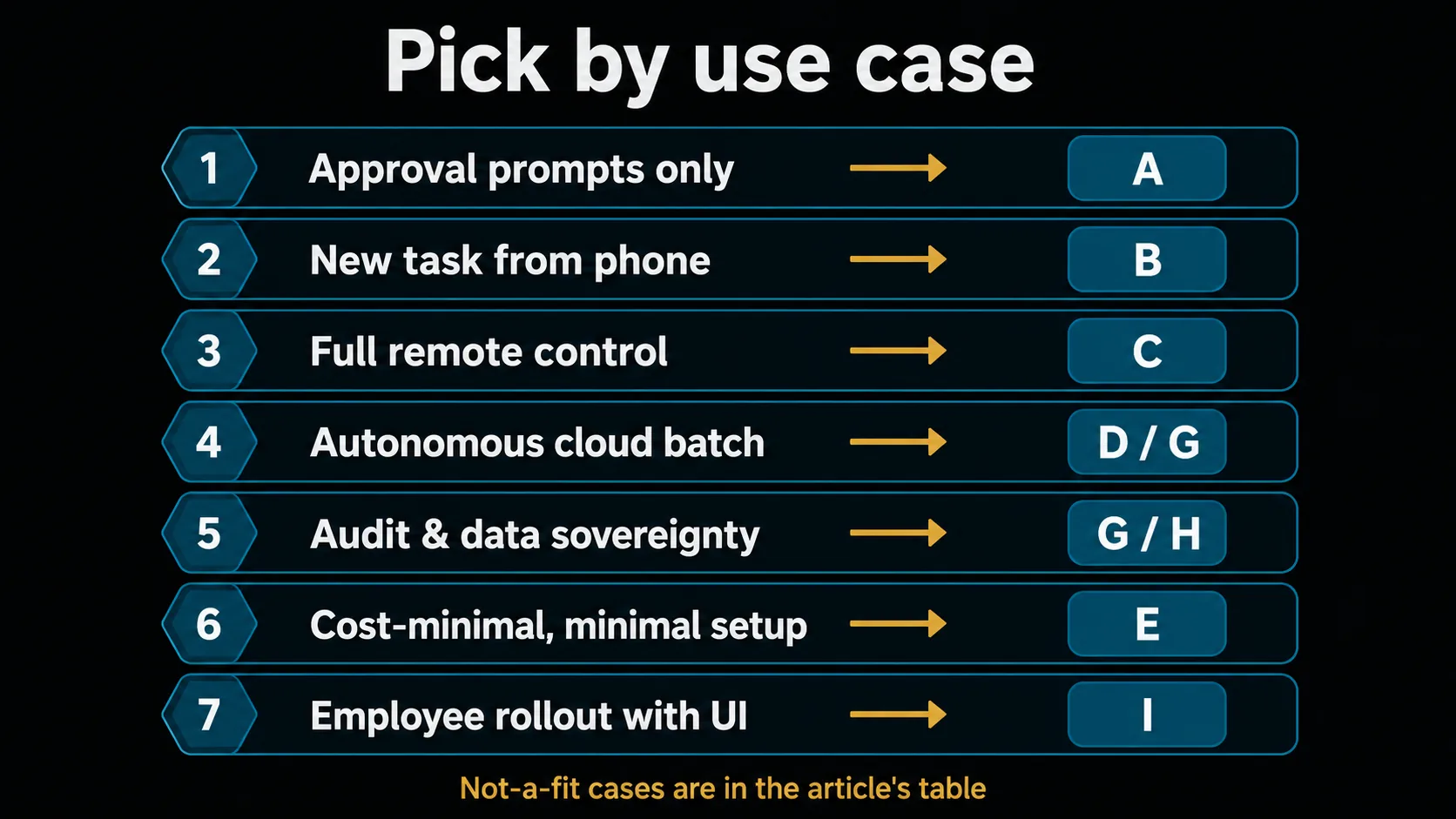
| What you want | Recommended | Not a fit for |
|---|---|---|
| Handle just approvals from your phone (work stays on the PC) | A claude-approval-server | multiple concurrent users / a PC you can't keep on |
| Throw a new job from outside and collect the result | B /dispatch | can't keep a Desktop-running PC awake / want API integration |
| Sit down and operate Claude Code from outside | C /remote-control | want it free (a paid plan is required) |
| Run large-scale parallel / autonomous batches in production | D Managed Agents (or G Bedrock AgentCore) | you only want interactive local control |
| Existing-cloud consolidation / audit logs / data sovereignty | G managed AI agent / H Claude Platform on AWS | approval-server use (the design is an LLM sandbox) |
| Full self-host / cost minimization | F VPS / Cloud Run / Fly.io | want to run on Lambda / Workers (no PTY) |
| Existing AWS contract + UI-inclusive employee productivity | I Claude for Enterprise | a team under 25 seats |
| US regulated — HIPAA | G commercial Bedrock + AWS BAA | Platform on AWS (not HIPAA-ready) |
| US regulated — FedRAMP High / IL4 / IL5 | G Bedrock GovCloud (or Vertex Assured Workloads) | Platform on AWS, Foundry |
| EU data residency | G' Vertex AI (eu) / G Bedrock (EU profile) | Platform on AWS (inference_geo us/global only) |
When A (the self-hosted OSS) is NOT the answer — honestly pointing elsewhere
The author's OSS, A, isn't a universal tool. If any of the following apply, an official feature or a cloud option fits better:
- Multiple people using it concurrently → C /remote-control (team) or I Claude for Enterprise (with SSO).
- Can't keep a PC always on / need 24/7 → F self-host, or D Managed Agents (cloud execution).
- Need full control, not just approvals → C /remote-control.
- Need audit logs / SSO / org management → I Claude for Enterprise, G Bedrock (CloudTrail), H Claude Platform on AWS (SigV4 + CloudTrail).
A is strong for "keep it light and self-hosted"; when the above are required, routing to another candidate is simply easier.
Finally, an individual/team × US/EU overview:
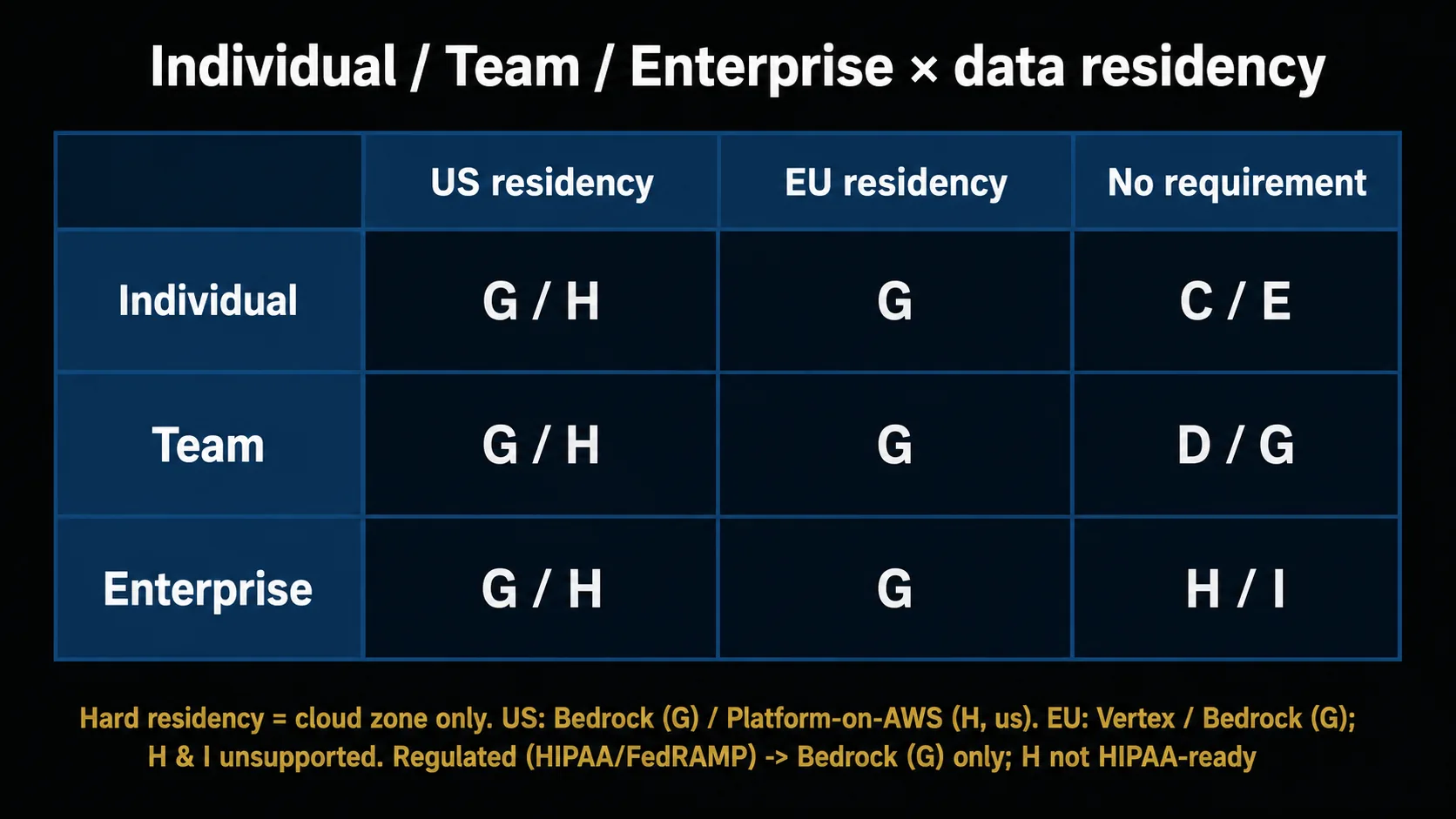
- Individual, no residency requirement: start with E Claude API direct or C /remote-control (Pro $20) — the shortest path to making your own work easier.
- Team (25+), UI-inclusive: I Claude for Enterprise ($40/user·month, SSO + Code). For API-led use kept inside a cloud boundary, G Bedrock; for Anthropic-native features with AWS auth, H Claude Platform on AWS. A two-tier split — developers on H, employees on I — works well.
- US regulated: G Bedrock (GovCloud) for FedRAMP/IL, HIPAA via Bedrock's BAA. Platform on AWS and Foundry are out.
- EU residency required: G' Vertex AI (
eu) or G Bedrock (EU profile). Platform on AWS and Claude for Enterprise process on Anthropic's infrastructure and fall out of a hard EU-residency requirement.
Wrapping up — four questions narrow it to one
Answer these four and it nearly decides itself.
- What's the use? approvals only (A) / new-task submission (B) / full control (C) / autonomous batch (D, G) / employee rollout (I).
- Is data residency a hard requirement? US regulated → Bedrock (HIPAA via commercial Bedrock + an AWS BAA; FedRAMP/IL via GovCloud). EU → Vertex (
eu) or Bedrock (EU profile). None → choose by use case. Platform on AWS isinference_geous/global only and not HIPAA-ready — don't route regulated workloads there. - What's the budget? $0/month → A / F (free tiers). Within a plan → B / C. Pay-per-use → D / E / H.
- Who operates it? you (A / F) / Anthropic (B / C / D) / cloud + Anthropic (G / H / I).
A pragmatic progression: start with C or E to make your own work easier, add A when you want to handle approvals from outside, and evaluate G / H / I at the team-rollout stage. Build steps and current pricing live in the official docs — confirm them right before adopting (the numbers here are as of 2026-06).
References
Reachability and the primary match of key dates/prices/plans/regions were confirmed on 2026-06-13 (specs move fast; re-confirm right before adopting).
Anthropic / general
- claude-approval-server (candidate A, MIT): https://github.com/YATA-NODE/claude-approval-server
- Claude Cowork / Dispatch requirements (candidate B, official Help; Pro/Max beta, macOS/Windows x64): https://support.claude.com/en/articles/13947068
- Claude Code Remote Control (candidate C, official docs): https://code.claude.com/docs/en/remote-control
- Claude Code Channels (official docs; research preview, v2.1.80+): https://code.claude.com/docs/en/channels
- Anthropic Managed Agents overview (candidate D): https://platform.claude.com/docs/en/managed-agents/overview
- Claude API pricing (candidate E; Opus 4.8 = $5/$25 per MTok): https://platform.claude.com/docs/en/about-claude/pricing
- Claude Platform on AWS (candidate H; HIPAA-ready not available = "Features not supported"): https://platform.claude.com/docs/en/build-with-claude/claude-platform-on-aws
- Claude Platform on AWS data residency (
inference_geous/global): https://docs.aws.amazon.com/claude-platform/latest/userguide/data-residency.html - Claude for Enterprise in AWS Marketplace (candidate I; $40/user·month, 25-seat minimum, 2025-07-15 listing): https://aws.amazon.com/blogs/awsmarketplace/anthropics-claude-for-enterprise-now-available-in-aws-marketplace/
US compliance
- Anthropic Public Sector FAQ (FedRAMP High / GovCloud): https://support.claude.com/en/articles/13756069-public-sector-faqs
- Amazon Bedrock FedRAMP High + DoD IL4/5 (GovCloud, 2025-05-23): https://aws.amazon.com/about-aws/whats-new/2025/05/amazon-bedrock-models-fedramp-high-dod-il-4-5-govcloud/
- Claude on Google Cloud FedRAMP High + IL-2 (2025-04-02): https://claude.com/blog/claude-on-google-cloud-fedramp-high
- AWS HIPAA Eligible Services Reference (Bedrock listed): https://aws.amazon.com/compliance/hipaa-eligible-services-reference/
EU residency / sovereignty
- Claude on Vertex AI (EU multi-region / regional residency): https://platform.claude.com/docs/en/build-with-claude/claude-on-vertex-ai
- AWS European Sovereign Cloud GA (2026-01-15, Brandenburg): https://press.aboutamazon.com/aws/2026/1/aws-launches-aws-european-sovereign-cloud-and-announces-expansion-across-europe
- Claude in Microsoft Foundry (East US2 / Sweden Central): https://learn.microsoft.com/en-us/azure/foundry/foundry-models/how-to/use-foundry-models-claude
This is an educational overview. Claude's remote features and cloud availability change fast; figures and URLs are as of 2026-06. Always confirm each service's latest docs before production use. Written by YATA-NODE.